







(KYIV, UKRAINE) – Ukraine is scrambling to protect its agricultural export lifeline after a sharp rise in Russian attacks on port infrastructure and foreign cargo ships cut seaborne shipments by 30 percent in July. The escalation has killed at least 21 people, forced major shipping lines to suspend calls, and raised urgent questions about how the country can move this year’s harvest to world markets without catastrophic financial losses for farmers.
The volume of agricultural exports by sea fell to no more than 3 million tonnes in July, down from higher levels in June. Traders are now asking the government to declare the maritime corridor officially halted so that they can formally notify counterparties of force majeure and explain why contracts cannot be physically performed. In August, shipments could drop further to between 1.5 and 2 million tonnes, a fraction of what is needed during the peak export season.
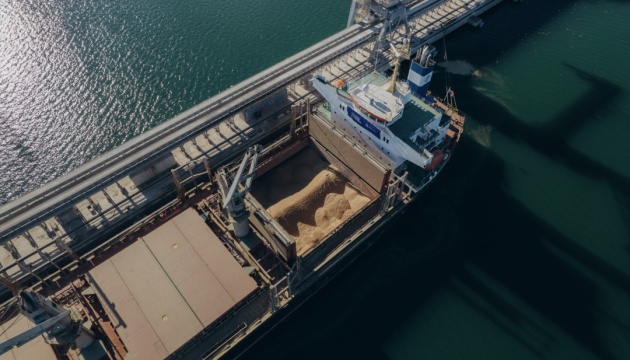
Russian forces have struck ports and civilian vessels nearly 30 times in recent weeks, with more than 20 of those attacks aimed directly at foreign ships. Since the start of the full scale invasion, the aggressor has damaged more than 1,000 items of port infrastructure and more than 220 vessels, many of them dry cargo ships used to carry Ukrainian grain. The latest wave of strikes has doubled maritime freight costs to 40 US dollars per tonne, or roughly 31 British pounds and 36 euros. Some international shipowners have told Ukrainian counterparts that they will not enter Ukrainian ports until the situation stabilises. Insurance companies are either suspending war risk policies or raising premium rates sharply. Global container carrier Maersk has temporarily stopped serving cargo through the Chornomorsk port.
The immediate effect is being felt in domestic purchase prices, which are falling as export routes narrow. Farmers, even those harvesting a decent crop, are no longer certain they will earn enough to finish the harvest and finance the autumn sowing campaign. “We are not saying the situation is critical right now. But in two or three months it could really become threatening. If export disruptions continue, producers will not have the money to repay the loans they took out during the spring sowing campaign, and there will be no money for sowing this autumn,” Denys Marchuk, deputy head of the All Ukrainian Agrarian Council, told Ukrinform.
Ukraine expects to harvest roughly 80 million tonnes of grains and oilseeds this year, roughly the same as last year. Of that total, about 45 million tonnes will need to be exported. Carryover stocks from the previous marketing season add a further burden. According to Maksym Hopka, an analyst at the Ukrainian Agribusiness Club, combined stocks of wheat, corn and barley left over from the 2025/26 marketing year stand at almost 10.2 million tonnes, about 2.5 times higher than the previous season. Wheat stocks are estimated at 3.8 million tonnes, corn at 5.7 million tonnes and barley at 0.7 million tonnes.
Sea transport has dominated Ukrainian agricultural exports since the maritime corridor was restored. In the first six months of 2026, total exports of grains, oilseeds and processed products reached about 27.3 million tonnes. Of that volume, 24.6 million tonnes, or 88.4 percent, moved by sea. The port of Chornomorsk handled nearly 10.9 million tonnes, Pivdennyi up to 8.3 million tonnes, and Odesa about 4.9 million tonnes. Volumes over the six months were up 14.2 percent compared with the same period last year, with seaborne shipments rising 13 percent.
Alternative routes saved Ukraine during earlier blockades. After Russia’s full scale attack in February 2022, almost all agricultural exports shifted to rail, road and Danube ports until the Black Sea Grain Initiative took effect in August of that year. When Russia pulled out of the deal in the summer of 2023, the Ukrainian Navy declared temporary routes for merchant ships, and the maritime corridor was back in permanent operation by September. Since then, more than 200 million tonnes of cargo have moved through the corridor, including more than 120 million tonnes of grain.
The alternative routes have not been abandoned, but their use has fallen sharply because overland transport is more expensive and cannot compete with sea freight on cost. “The capacity is still there, but it is not enough to meet the monthly export potential. One way or another, we are seeing a partial shift of flows to the Danube, and freight costs on that route for grains are rising. I think rail shipments will also pick up. More road transport is possible too, but that will mainly apply to grain from the western regions. For road haulage from central Ukraine, the economics are very poor, it is simply not profitable,” Marchuk said.
Ukraine survived earlier blockades partly because it built up storage capacity. Hopka said the country now has storage for roughly 53 to 54 million tonnes. Small and medium farms have also added their own facilities, which may not be fully captured in official statistics. Even so, with large carryover stocks and a possible slowdown in exports, there could be a shortage of free storage just as the corn harvest begins. Some of the new crop will probably have to be stored in polymer sleeves, a method that proved its worth in 2022 and 2023. One sleeve can hold up to 200 tonnes of grain, and with the right technology the crop can be kept for nine months to a year, or up to 18 months with additional drying.
Marchuk argued that the state must widen its war risk insurance programme to cover agricultural products. At present, the programme covers various types of equipment but not farm goods. “I believe broadening this list is one of the most necessary steps,” he said. He also urged the government to introduce tax and credit holidays, offer cheap refinancing, and review the criteria for granting critical enterprise status to agricultural companies. Without exports, many farms will be unable to meet the cash turnover requirements needed to retain that status.
A separate and immediate concern is a plan by the state railway company Ukrzaliznytsia to raise freight tariffs by 30 percent from 1 August. Marchuk called the proposal a heavy additional burden at a time when costs have already climbed and the cost of the spring sowing campaign was about 35 percent higher than a year earlier. “Now we have problems with sea supply, grain prices are falling, and the cost of domestic transport is set to rise. All of this means additional financial losses. We propose that before taking such a step, the railway should align tariffs for agricultural products with those for other freight classes, for instance builders or metals. That way, Ukrzaliznytsia could raise at least part of the money it needs while reducing the pressure on farmers,” he said. Consultations on the tariff issue are continuing, including discussions between industry associations and the new government.
Hopka said time is the most critical resource. It is needed both to adapt the logistics system and to secure safe passage for shipping in the Black Sea. “Previous experience has shown that Ukraine is capable of restoring exports even under difficult conditions. The main task for the agricultural sector is a pragmatic assessment of risks, readiness for different scenarios and early preparation for possible logistical constraints,” he concluded.