









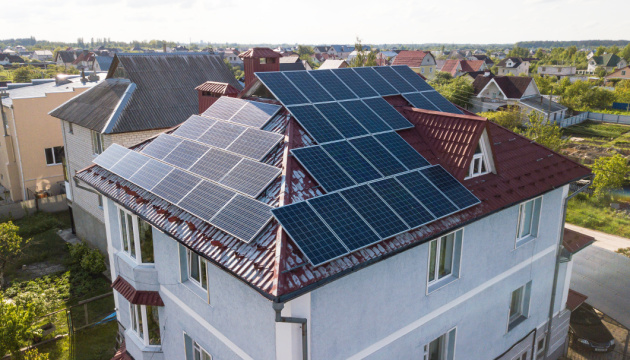
(KYIV, UKRAINE) – Installing a home solar power station has become one of the main ways for Ukrainian households to secure a degree of energy independence. However, choosing the right panels and connecting them to the grid involves several practical steps that require attention from the very start.
The first task is to decide what the solar station is meant to do and, on that basis, how much capacity is needed. If the goal is simply to power household appliances, the easiest starting point is the home electricity bill. It shows total consumption over a given period, such as a year, and makes it possible to work out roughly how much electricity the panels should supply. If the station is intended as backup power for specific devices during blackouts, then the focus should be on the wattage of those appliances alone.
The non governmental organisation Ecodia offers a simple example using a mobile phone charger. If a phone charges at 10 watts and takes four hours to charge, it consumes 40 watt hours during that cycle. The same approach can be applied to every appliance in the home. These calculations give approximate figures, but they provide a baseline for selecting panels and designing the system.
It is important to remember that the capacity printed on a solar panel’s documents is the peak figure, the maximum the panel can produce under ideal conditions. In real conditions, output depends on the season, the angle at which sunlight hits the panel, and the weather on any given day. Specialists advise households to base their planning on what the panel will produce on the least sunny days. For example, a 400 watt panel installed in Kyiv will generate about 10 kilowatt hours of energy in December, which works out to roughly 0.33 kilowatt hours per day. A person working remotely who needs a charged laptop at all times may require several 400 watt panels to get through the winter.
Solar panels produce electricity only during daylight hours. To have power around the clock, a household must pair the solar station with an uninterruptible power supply, and that cost must be built into the budget from the outset. The device contains a voltage converter and a battery. When grid power is available, it charges from the network. During an outage, it feeds electricity to appliances from its own storage.
The market currently offers several types of solar panels, each with different efficiency levels. A classic polycrystalline panel has an efficiency of 17 to 18 percent. Its main advantage is price, but meeting a household’s electricity needs may require a large area of roof or land. A monocrystalline panel is more expensive but delivers an efficiency of 22 to 24 percent and lasts longer. Because it is more efficient, a monocrystalline array needs less space than a polycrystalline one of the same total capacity.
There are also flexible and thin film panels. Thin film panels have an efficiency of about 10 to 12 percent but perform better in low light conditions. Flexible panels have even lower efficiency but can be mounted on uneven surfaces, such as facades with complex geometry.
In Ukraine, installing a solar station does not require a construction permit. Owners of private houses, summer cottages and outbuildings do not even have to arrange a structural survey of the building. In multi storey blocks, however, a technical inspection report is mandatory. Engineers must confirm that the roof or facade can bear the extra load and that the building will remain completely safe for all residents.
Regardless of whether the property is a private house or an apartment block, a professional installation company must be engaged. Self installation is dangerous because wiring and mounting errors can later cause a fire.
The procedure for dealing with the local distribution company, known as oblenergo, is the same across the country. The electricity distribution operator DTEK Merezhi outlines the following sequence. First, an application to connect the generating unit is submitted to the oblenergo. The relevant forms and the list of supporting documents can be found on the oblenergo website. Second, a single line diagram is prepared, either independently or with the help of the installation company. Third, if the capacity required is greater than that stated in the existing contract with the oblenergo, a separate application for a capacity increase must be filed. Fourth, a bidirectional meter is installed where possible. The meter can be bought from the oblenergo, among other sources. Specialists from the distribution company will not only fit the meter but will also check the metering unit, verify that the connection scheme is correct, and confirm that parallel operation with the grid is safe.
Selling surplus electricity into the grid is a separate matter. The contract for that is signed not with the oblenergo, which acts as the distribution operator, but with the electricity supplier serving the region.