









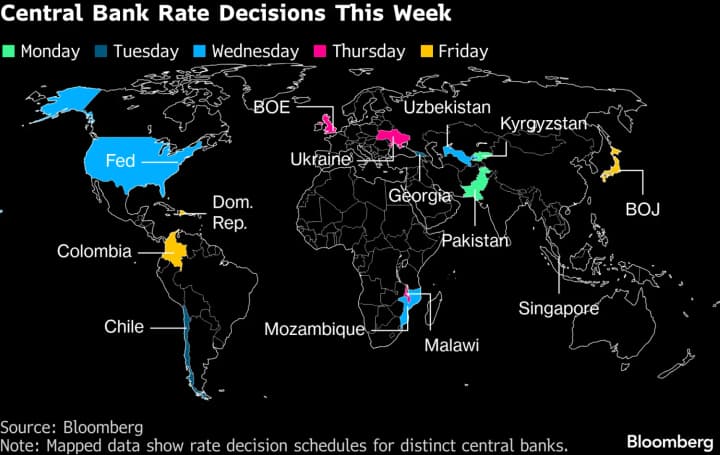
(WASHINGTON, USA) – Central banks across the Group of Seven nations are preparing for a series of interest rate decisions this week as oil prices approach $100 per barrel, intensifying inflationary risks that could force policymakers to signal a return to rate increases by the autumn.
Brent crude currently trades at $90 per barrel (around £71 or €82), having briefly exceeded $100 earlier in the week for the first time since May. The rise has been driven by the expanding conflict in the Middle East, which has effectively halted commercial shipping through the Strait of Hormuz and disrupted roughly one fifth of global liquefied natural gas flows.
The US Federal Reserve, the Bank of England and the Bank of Japan take centre stage in the week ahead. Most economists expect no change to rates in the coming days, but investors are pricing in the possibility that several central banks could resume raising rates as early as September.
Bloomberg Economics expects the Federal Reserve to hold its key rate steady. However, Fed Chair Kevin Warsh is likely to stress that inflation remains above desired levels. Softer than expected US inflation data published earlier could serve as a counterargument against an immediate hike this month.
Alongside the Fed decision, the United States will publish second quarter GDP figures, the PCE inflation index and consumer spending data. These releases will shape market expectations for the policy path through the remainder of the year.
Rising oil and gas prices, large scale investments in artificial intelligence and uncertainty surrounding the tariff policy of President Donald Trump are among the main factors that could accelerate inflation once again, according to Bloomberg.
In Japan, investors await the Bank of Japan’s decision following the release of industrial production, retail sales and Tokyo inflation data. Central banks in Singapore and Pakistan will also hold monetary policy meetings during the week.
The eurozone will publish preliminary data on economic growth and inflation. GDP in the currency bloc is forecast to have grown by 0.2 percent in the second quarter. Annual inflation in July may have accelerated to 2.9 percent, adding to the case for caution at the European Central Bank.
The Bank of England is expected to leave its rate unchanged, although a section of the committee may support an increase due to inflation risks. The pound currently trades at approximately $1.27 (around €1.16), with UK inflation remaining above the official 2 percent target.
Monetary policy decisions are also expected during the week from the central banks of Ukraine, Chile, Colombia, Mozambique, Malawi and other countries. Investors will also monitor South Korea’s external trade statistics, Mexico’s economic indicators and Brazil’s inflation data, all of which could influence global monetary policy expectations.
Oil prices could push above $100 per barrel before the end of the year as the Middle East situation escalates further, according to separate Bloomberg reporting. Sustained energy costs at these levels would complicate the inflation outlook across advanced and developing economies alike.