








(NAIROBI, KENYA) – Kenya’s pension schemes sharply increased their holdings of quoted shares in the first half of 2026, moving more capital towards the Nairobi Securities Exchange (NSE) as falling government bond yields and rising share prices made equities more attractive.
Data from the Retirement Benefits Authority (RBA) shows pension schemes increased their quoted equity holdings by KES 130.51 billion to KES 443.35 billion in the six months to June. That was a 41.72% increase from KES 312.84 billion at the end of December 2025.
The June allocation was equivalent to about $3.42 billion, GBP 2.54 billion or €2.97 billion at indicative exchange rates for 19th August 2026.
Equities accounted for 14.37% of total pension assets in June, up from 11.13% at the end of last year. This was the highest allocation to quoted shares in five years and the strongest since December 2021, when equities represented 16.45% of pension assets.
The shift towards shares took place as pension schemes reduced their holdings of government securities by KES 35.14 billion, or 2.4%, to KES 1.43 trillion from KES 1.47 trillion.
The government securities allocation was worth about $11.05 billion, GBP 8.19 billion or €9.58 billion at the 19th August exchange rates.
The reduction brought government paper’s share of pension portfolios down to 46.35%, from 52.14% at the end of December.
The increase in pension fund exposure to equities was also visible over a longer period. The KES 443.35 billion allocation in June was 73.8% higher than the KES 255.2 billion held in quoted shares in June 2025.
The RBA linked part of the shift to easier monetary conditions, which have reduced yields on new government debt and fixed deposits. This has made equities relatively more attractive to institutional investors seeking higher returns.
The Central Bank Rate fell from 9% in January to 8.75% in February and remained at that level through June.
“For pension schemes, this lower interest rate environment continues to exert downward pressure on yields on new government debt and fixed deposits,” the RBA said.
The authority said the change was accelerating the movement of capital away from traditional fixed income investments towards equities and alternative asset classes that could provide higher returns.
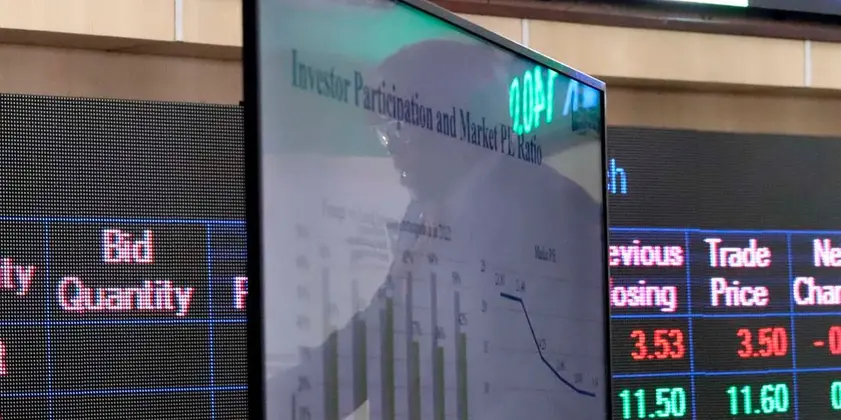
The movement into shares has also coincided with a strong recovery in Kenya’s equity market. Improved corporate earnings, dividend payments and renewed investor confidence helped support the NSE during the first half of the year.
The NSE 20 Share Index and the Nairobi All Share Index each gained about 20% in the first six months of 2026. The NSE 20 Share Index reached 3,755.44 points, while the Nairobi All Share Index rose to 224.15 points.
Market capitalisation increased by 28% to KES 3.76 trillion during the period. That was about $29.0 billion, GBP 21.5 billion or €25.2 billion.
New listings also helped increase market activity. Family Bank was listed in June, following the Kenya Pipeline Company initial public offering in March. The two developments contributed to greater liquidity and investor participation in the domestic equity market.
The RBA said sustained price gains in major blue chip shares allowed equities to absorb part of the capital released as pension schemes reduced exposure to lower yielding fixed income assets.
“Building on a 41.72% growth in the first half of 2026, this 12 month period reflects market trajectory, strong confidence and sustained rallies in key blue chip counters, allowing equities to absorb much of the capital rotated out of lower yielding fixed income assets,” the RBA said.
Despite the increase in equity investment, pension schemes remain heavily concentrated in a small number of sectors.
Banks accounted for 47.04% of the KES 443.35 billion quoted equity portfolio. Telecommunications and technology followed with 31.26%, while energy and petroleum accounted for 15.1%.
Together, the three sectors represented 93.41% of pension schemes’ quoted equity holdings, leaving a relatively small share invested across other areas of the economy.
The decline in interest rates has also affected pension schemes’ fixed deposit holdings. Allocations to fixed deposits fell by 15% to KES 48.02 billion from KES 56.5 billion.
The June allocation was equivalent to about $371 million, GBP 275 million or €322 million. The previous KES 56.5 billion holding was about $436 million, GBP 323 million or €378 million.
The movement away from traditional fixed income assets formed part of a wider effort by pension schemes to diversify their portfolios.
The four largest asset classes, government securities, guaranteed funds, quoted equities and property, accounted for 88.04% of total pension assets in June. This was down from 90.43% in December.
Guaranteed funds increased by 14.29% during the six months to KES 597.07 billion. The allocation was worth about $4.61 billion, GBP 3.42 billion or €4.00 billion.
Offshore investments also recorded strong growth, rising by 24% to KES 105.69 billion. That was about $816 million, GBP 605 million or €708 million.
The latest figures point to a significant change in the investment mix of Kenya’s pension industry. As domestic interest rates have fallen and the NSE has recorded strong gains, pension funds have increased their exposure to equities while reducing allocations to government securities and fixed deposits.
The shift also gives pension funds a larger stake in the performance of listed Kenyan companies, particularly banks, telecommunications and technology firms, as the market enters the second half of 2026.
Indicative currency rates used for the conversions: $1 = KES 129.46, GBP 1 = KES 174.67 and €1 = KES 149.34 on 19th August 2026. These are indicative market rates rather than transaction rates.