





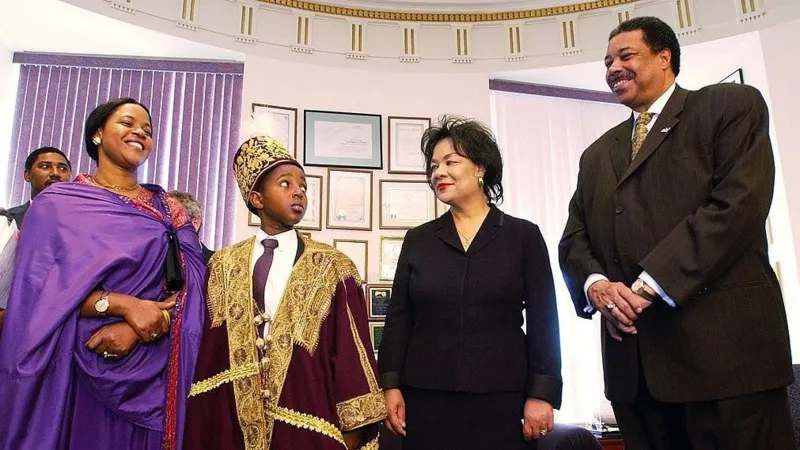
(FORT PORTAL, UGANDA) – King Oyo Nyimba Kabamba Iguru Rukidi IV, the Omukama of Tooro who died on Thursday 27th August at the age of 34, leaves behind a financial legacy tied to land, government support and the weight of a 200 year old institution. His personal wealth was modest by global royal standards. His institutional wealth was substantial. The distinction matters.
King Oyo Networth
The Uganda government pays monthly stipends to traditional leaders. The figures are not published as a matter of routine. Budget documents and past parliamentary debates indicate that the largest traditional institution, Buganda Kingdom, receives an annual allocation in the region of UGX 1.7 billion ($460,000 / £350,000). Tooro Kingdom, being smaller, receives less.
Estimates place the annual government support for Tooro at between UGX 500 million and UGX 800 million ($135,000 to $216,000 / £103,000 to £165,000). This money is meant for the running of the kingdom, not for the personal use of the King. In practice, the line is often blurred. The King had access to official residences, vehicles, staff and security. He did not pay rent at the palace in Fort Portal. He did not buy his own cars. He lived, in effect, like the head of a small but well funded state institution.
The kingdom’s real wealth lies in land. Tooro Kingdom controls extensive tracts of land across the districts of Kabarole, Kamwenge, Kyegegwa and Kyenjojo. Much of this land is held under customary tenure, with the kingdom acting as trustee for the people. Some of it is leased to tenants, including tea estates, hotels and commercial farms. The exact value is difficult to pin down.
Land prices in Fort Portal City and its surroundings have risen sharply over the past two decades. Prime plots near the palace now sell for between UGX 80 million and UGX 150 million per acre ($21,600 to $40,500 / £16,500 to £31,000). The kingdom’s total land holdings could be worth several hundred billion Uganda Shillings. King Oyo, as the head of the institution, had a claim to the use of these assets. He did not own them outright. The next King will inherit the same access.
Foreign assets are harder to trace. King Oyo travelled widely from a young age. He visited the United States at the age of 10 on a humanitarian mission for Aids orphans. He met Libyan leader Muammar Gaddafi in 2001 when he was nine years old. The meeting was part of a visit by Gaddafi to Uganda during a period when the Libyan leader was courting African traditional leaders and governments. Gaddafi had a well documented habit of offering financial support to kingdoms and chieftaincies across the continent. Some of this money went into development projects. Some went into personal accounts.
There is no public record of King Oyo receiving direct payments from Gaddafi. The King was a minor at the time. Any financial arrangement would have been handled by his regents. That said, the meeting itself was symbolic. It placed Tooro on a map that included some of Africa’s most politically connected traditional institutions.
King Oyo’s personal income sources were limited. He was a student for much of his early reign. He attended schools in Uganda and later studied abroad, though the details of his academic record are not widely publicised. He had no known business ventures. He did not hold any corporate directorships. He was not listed as a shareholder in any Ugandan company.
His income came from the kingdom’s budget, from government support and from occasional gifts and donations made to the institution. Some of these gifts were substantial. Foreign visitors, including diplomats and business delegations, often made donations to the kingdom in cash or in kind. The King’s office received these on behalf of the institution. It would be a mistake to describe them as personal income.
The King Oyo Scholarship Fund was one of his most visible initiatives. The fund supported the education of young people from the Tooro region. It was financed through donations from well wishers, corporate sponsors and the kingdom’s own resources. The King was its public face. He did not own the fund. He did not draw a salary from it. His role was to lend his name and his office to a cause that mattered to his subjects.
His lifestyle was not extravagant by global royal standards. He lived in the palace, travelled in official vehicles and wore the robes of his office. He did not own a fleet of luxury cars. He did not have a private jet. He did not maintain homes in London or New York. His public appearances suggested a man who understood that his role was to be a custodian of an institution, not a celebrity spending its resources. That said, the trappings of a Ugandan king are not cheap. The royal household employed dozens of people. The palace required maintenance. The King’s security detail was provided by the state. All of this was paid for by the kingdom’s budget and by the Uganda government.
The connection to Gaddafi is worth examining in a business context. Gaddafi’s Libya invested heavily in Uganda during the 1990s and early 2000s. Libyan money went into hotels, telecommunications and agriculture. The Libya Africa Investment Portfolio, a sovereign wealth fund, held stakes in several Ugandan assets. Gaddafi also cultivated traditional leaders as part of his vision of a United States of Africa. King Oyo, as one of the youngest and most photographed monarchs on the continent, was a natural point of contact.
The 2001 meeting in Tooro was widely covered. Gaddafi presented himself as a patron of African culture. The young King was a symbol of continuity and tradition. It is unlikely that any direct financial relationship survived the fall of Gaddafi in 2011. Libyan assets in Uganda were frozen and later sold. There is no evidence that King Oyo retained any connection to Libyan state funds after that period.
The King’s net worth, if one must put a number on it, was likely in the range of $1 million to $3 million (£760,000 to £2.3 million) in personal terms. This would include the value of any personal property, cash holdings and investments held in his own name. It would not include the kingdom’s land or assets, which are held in trust for the people of Tooro. The kingdom’s institutional net worth is far larger. A conservative estimate would place it at $50 million to $100 million (£38 million to £76 million), based on land values and the income stream from government and private leases. The King had the use of these assets during his lifetime. He did not have the right to sell them.
His death triggers a succession process that will involve the Babiito clan and the kingdom’s traditional institutions. The heir, a Prince whose identity has not yet been revealed, will inherit the throne and the institutional wealth that comes with it. The new King will also inherit the challenge of managing a kingdom that is culturally significant but financially constrained. The annual government stipend is enough to keep the palace running. It is not enough to fund major development projects. The kingdom relies on donations, land leases and the goodwill of its subjects to maintain its operations.
King Oyo’s financial legacy is therefore not one of personal enrichment. It is one of institutional continuity. He reigned for 31 years. He saw the kingdom through periods of political change and economic pressure. He kept the institution intact. That, in the world of traditional monarchies, is the most valuable asset of all. His successor will inherit a kingdom that is solvent, respected and deeply rooted in the history of western Uganda. Whether that translates into a large personal fortune is beside the point. The King was a custodian, not an owner. His wealth was the kingdom itself.
The late King’s connection to Gaddafi remains a footnote in a life that was otherwise defined by duty and service. The meeting in 2001 was a moment of political theatre. Gaddafi was seeking influence in Africa. The young King was a convenient symbol. The relationship did not define King Oyo’s reign. It did however place him, at the age of nine, in a room with one of the most controversial figures of his era. He handled it with the composure of a monarch who had been trained for public life since the age of three.
The King’s death has left a void in Tooro. The next King will inherit a kingdom that is culturally rich and financially stable. That throne is worth more than any bank balance. It is the reason King Oyo’s name will be remembered long after the details of his finances are forgotten.