




(NAIROBI, KENYA) – Kenya Commercial Bank (KCB) has established a medium term sustainability bond programme of up to KES 300 billion, equivalent to about $2.32 billion / £1.72 billion / €2.00 billion, to finance green, blue and social investments over more than five years.
The programme is subject to regulatory approvals and prevailing market conditions and is designed to direct capital towards projects with measurable environmental and social benefits.
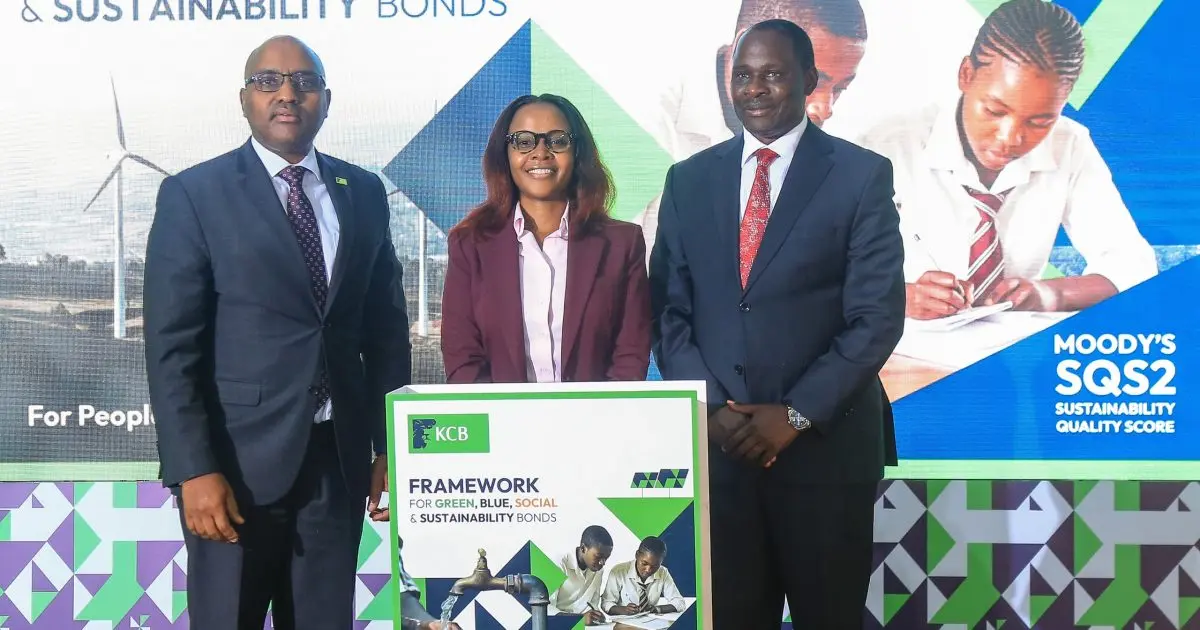
The sustainability bond framework was launched at the KCB Leadership Centre in Karen, Nairobi, bringing together government officials, investors, development partners and financial sector representatives.
The framework will support financing for renewable energy, energy efficient buildings, clean transport, sustainable agriculture, water and waste management, and marine and coastal ecosystems.
Its social financing component will support affordable housing, healthcare, micro, small and medium enterprises (MSMEs), women and youth led businesses, as well as projects aimed at creating jobs and supporting livelihoods.
KCB Group Chief Executive Officer Paul Russo said the framework would provide a structured mechanism for directing capital towards investments that deliver measurable environmental and social outcomes.
“The programme will support projects in renewable energy, energy efficient buildings, clean transport, sustainable agriculture, water and waste management, as well as marine and coastal ecosystems,” Russo said.
He said KCB had progressively integrated sustainability into its business, including financing decisions and risk management. The bank has aligned its sustainability agenda with 14 of the 17 United Nations Sustainable Development Goals.
Russo said the framework was intended to bring together capital, purpose and accountability by directing funding towards projects that deliver measurable development outcomes. He said the programme’s performance would ultimately be assessed through its impact on cleaner, more resilient and inclusive communities.
The launch also drew support from the National Treasury, which said the framework could help expand Kenya’s use of capital markets to finance development priorities.
Cabinet Secretary for the National Treasury and Economic Planning John Mbadi said the framework reflected the continued development of sustainable finance and increasing sophistication in Kenya’s financial markets. His remarks were delivered by Cyrell Odede Wagunda, Principal Secretary for Public Investments and Assets Management.
Mbadi said the framework demonstrated how Kenya’s capital markets could structure financial solutions to meet changing investor needs while supporting sustainable development.
He said the programme could help mobilise substantial green capital for national priorities, reducing reliance on traditional sources of finance and strengthening the resilience of the economy.
The Treasury also reaffirmed the government’s commitment to sustainable development through green financing and the allocation of capital to productive investments.
Mbadi described the framework as a major step towards financing large infrastructure projects through market based mechanisms. He also commended KCB’s board and management and said the Treasury would continue working with the bank on financing solutions linked to sustainability.
The programme comes as Kenya seeks to deepen its capital markets and expand the role of private and institutional capital in financing infrastructure and development. The framework gives investors a defined structure through which funding can be channelled into projects with environmental and social objectives.
The KCB programme is therefore expected to provide an additional source of long term capital for sectors including energy, transport, agriculture, housing, healthcare and small business while supporting the wider development of sustainable finance in Kenya.
The launch was attended by government officials, investors, development partners and financial sector participants, who backed the framework as a means of expanding sustainable financing and increasing access to long term capital for investments aligned with Kenya’s development priorities.