
(NAIROBI, KENYA) – The standard gauge railway recorded an operating profit of KES 3.2 billion ($24.9 million / £19.4 million) in the fiscal year 2025/26, the first time in nine years since it was launched in 2017. The result follows years of losses that had raised questions about the railway’s operational viability despite high operating costs.
The performance was driven by continued growth in cargo volume and government interventions. Kenya Railways Corporation Managing Director Philip Mainga said the state agency has taken over full operations of the SGR. Passenger services also grew, with both the SGR and the metre gauge railway recording gains in the period. The metre gauge railway recorded the stronger year on year increase in passengers.
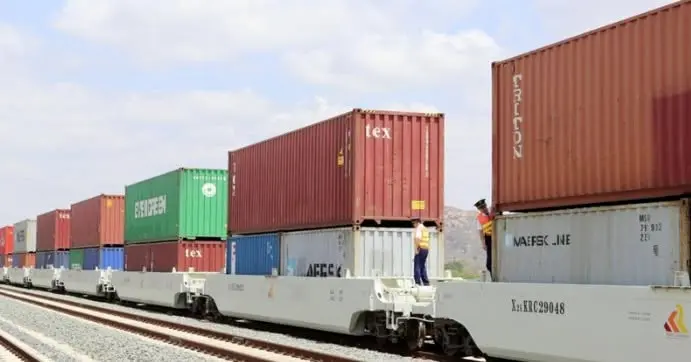
According to KRC’s annual report and financial statements for the year under review before Parliament, the SGR remained the corporation’s strongest freight segment during the 2025/26 period. It recorded 8.2 million tonnes of freight, the highest volume since operations began nine years ago.
Beyond cargo growth, the SGR’s performance was supported by improved operational reliability, better cargo evacuation at the port of Mombasa, faster asset turnaround times and stronger customer engagement and service delivery. The KRC annual report says the sustained growth shows the increasing role of the SGR in moving cargo along the Mombasa to Nairobi corridor and supporting the corporation’s contribution to national logistics and trade facilitation locally and regionally.
The Mombasa to Nairobi SGR project cost taxpayers KES 327 billion ($2.54 billion / £1.99 billion). The Nairobi to Naivasha extension cost another KES 150 billion ($1.17 billion / £0.91 billion). Financing for the two lines came largely from loans from the Chinese government.
The performance represents the highest SGR freight volume recorded over four years. It is an increase of 1.11 million tonnes compared with the 7.04 million tonnes recorded in the 2024/25 financial year, 6.4 million tonnes in 2023/24 and 6.3 million tonnes in the 2022/23 financial year.
The annual report shows that the SGR generated KES 21.8 billion ($169.6 million / £132.3 million), accounting for 84% of the corporation’s operating revenue. Total operating expenditure increased slightly from KES 18.33 billion ($142.6 million / £111.3 million) in the 2024/25 period to KES 18.52 billion ($144.1 million / £112.4 million) during the 2025/26 period, an increase of KES 191.9 million ($1.5 million / £1.2 million). Spending remained KES 1.58 billion ($12.3 million / £9.6 million) below the approved budget.
Mr Mainga said the overall freight achievement reflects KRC management actions and interventions to drive freight movement and growth in the state agency. He said the combined trend of the SGR and the metre gauge railway indicates rising use of the railway system and shows a split between the two networks.
The annual report shows that while the SGR is driving sustained freight growth, the metre gauge railway’s strongest recent performance is in passenger services.
Key strategic interventions that drove the strong SGR freight performance included an increase in average daily freight train operations from 7.96 trains in 2023/24 and 8.27 trains in 2024/25 to 9.67 train pairs in 2025/26. This enhanced network capacity and freight throughput, supported by the full takeover of SGR services.
Freight handling capacity was strengthened through the deployment of additional cargo handling equipment, including three reach stackers at the port of Mombasa, improving cargo evacuation and operational efficiency. Optimised rolling stock led to wagon utilisation of 70% and improved fleet productivity. Better planning and coordination led to improved train scheduling, reduced turnaround times and enhanced service reliability.
The SGR has been operated under a shared partnership transitioning towards full local ownership, run by KRC and the Chinese firm Africa Star Railway Operation Company, known as Afristar. Afristar, a subsidiary of China Road and Bridge Corporation, was originally awarded a 10 year contract in 2017 to operate and maintain the railway. The Kenyan government negotiated a gradual phase out to cut operational costs and localise management.
Until recently, KRC handled 98% of all operational functions, including day to day services such as passenger ticketing for the Madaraka Express, security, fuelling, track maintenance and rolling stock management. Afristar handled the remaining 2% of critical technical operations, including high level signalling systems, dispatch coordination, freight management and specific yard operations at the Port Reitz and Nairobi termini.
A report by the Parliamentary Budget Office on budget options for the 2021/22 financial year and the medium term showed that the cost of running the SGR far outweighed revenues in its fourth year of operation, despite the railway’s contribution to hauling cargo and passengers between Mombasa and Nairobi. The government had projected May 2019 as the year for the project to break even.
Between January and May 2020, the cost of operating the SGR was KES 7.5 billion ($58.4 million / £45.5 million) compared with KES 5 billion ($38.9 million / £30.4 million) in revenue. The cost of running the SGR was highest in 2019 at KES 17.9 billion ($139.3 million / £108.7 million) against KES 13.5 billion ($105.1 million / £82 million) in revenue.
In 2018, KES 14 billion ($108.9 million / £85 million) was spent to run the project against KES 5.5 billion ($42.8 million / £33.4 million) in revenue. Between June and December 2017, operational costs were KES 7.5 billion ($58.4 million / £45.5 million) against KES 1 billion ($7.8 million / £6.1 million) in revenue as questions emerged about whether the project was economically viable.
The construction and expansion of the broader western SGR network, including the Naivasha to Kisumu to Malaba corridor, remain driven by agreements with China Communications Construction Company and China Road and Bridge Corporation.