





(NAIROBI, KENYA) – The operator of a Kenyan investment scheme cited in court for fraud is recruiting thousands of investors into a new platform, asking them to deposit $400 (KES 51,800 / GBP 307) to unlock funds estimated at close to KES 1 billion ($7.7 million / GBP 5.9 million) frozen in the collapsed venture.
Carl Grindan, who uses the alias “Prof Carl”, has given more than 12,000 Kenyan investors until 25th September to deposit the money or forfeit cash held in accounts belonging to Quant Vest Stock Exchange (QVSE), according to notices sent through the encrypted messaging app BonChat.
The deposits are being directed to a new entity called Apollo Exchange, which Grindan claims will transfer balances out of QVSE and allow withdrawals from 25th September. He has promised investors a daily return of $12 (KES 1,554 / GBP 9.2) on the new platform.
“This is equivalent to us opening up a brand-new safe withdrawal channel for everyone on the new platform, bypassing the old channel to safely redeem the money that rightfully belongs to you,” Grindan said in a message to investors.
“The principal and earnings in every member’s account exist in the backend.”
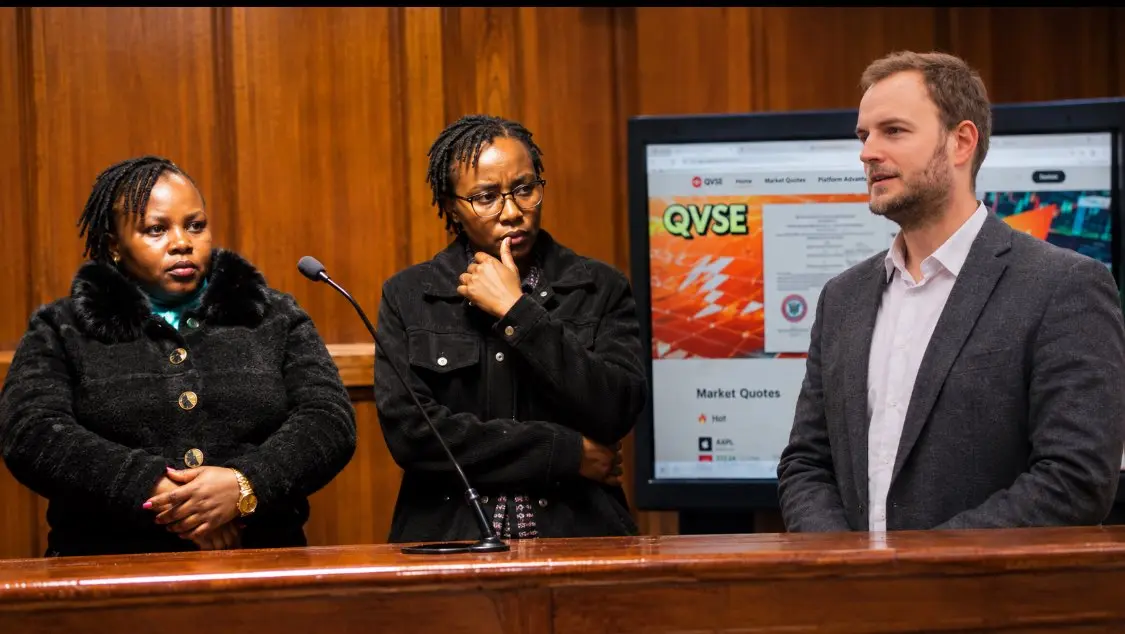
The development emerged on the same day that two Kenyan agents of QVSE were charged in a Nairobi court with fraudulently inducing trading in securities and running an investment scheme without a licence from the Capital Markets Authority (CMA).
Ruth Mueni Kimeu and Mary Katuma Mwangangi are accused of inducing members of the public between 15th January 2026 and 17th September 2026 to subscribe for and trade in securities through QVSE and its parent company, Global Investment Group (GIG), by publishing deceptive statements and making false promises.
“The Plaintiffs aver that they and their ancestors have lived on, cultivated, and developed the suit property for generations and that the land has been passed down through families, with no formal title deeds issued to them,” the charge sheet reads in part, referring to the fraudulent inducement claims.
Ms Kimeu, an employee of Machakos County, and Ms Mwangangi, a primary school teacher, denied two counts of collecting investments and fraudulently inducing investment in securities.
Prosecutors say the two persuaded Kenyans to trade in securities through QVSE using deceptive statements and false promises.
As the CMA and the Directorate of Criminal Investigations (DCI) continue to probe QVSE and GIG, a company linked to American Marc Hudon, the individual behind the scheme has opened a new firm and resumed operations.
Since January, QVSE has drawn thousands of Kenyans, among them teachers, small scale traders, professionals and boda boda operators, with promises of large returns from trading in United States stocks such as Apple, Nvidia and Tesla.
The model relied on copy trading, in which a signal provider such as Grindan alerts investors to enter trades using digital capital allocated to mirror QVSE’s preferred positions. Investor funds are held in stablecoins, with withdrawals expected to be made by trading cryptocurrencies on Binance.
Investors were required to deposit $500 (KES 65,000 / GBP 383) or $1,000 (KES 130,000 / GBP 766) into their QVSE accounts. Grindan sent trading signals through BonChat, which listed 12,005 investors.
Those who deposited $500 earned $6 (KES 777 / GBP 4.6) per trade, while a $1,000 account earned $12 (KES 1,554 / GBP 9.2) per trade. Signals were sent twice daily, allowing investors to double their returns.
On 5th September, Grindan froze the QVSE accounts, accusing some members of creating multiple accounts to raise their trading limits. He then asked investors to make additional deposits equal to their initial principal, between KES 65,000 and KES 129,000, to reactivate their accounts, a promise that proved false.
A week later, on 12th September, the CMA listed QVSE and GIG among 15 entities it said were operating illegally in Kenya without permits to support their businesses.
“These entities are the subject of active investigations by the Directorate of Criminal Investigations in collaboration with the Capital Markets Authority and other law enforcement agencies,” the CMA said.
“The Authority strongly cautions the public against dealing with entities and persons disguising their fraudulent activities as investment opportunities.”
Grindan dismissed the regulator’s warning and urged investors to commit more money, claiming the CMA notice lacked substance.
“The content is merely performative and lacks real substance; it is simply a way for them to signal to the public that they are taking action, rather than being based on anything tangible,” read a message sent on BonChat.
Apollo is the latest platform Grindan has run under GIG, following QVSE and an earlier scheme known as PCEX, which the CMA also said operated illegally in Kenya.
PCEX used a similar copy trading model, with investors depositing $500. The scheme encouraged members to recruit others by awarding bonus signal transactions to boost account holdings. PCEX announced a temporary closure on 16th April 2025, citing internal issues and pending regulatory processes, and Grindan told investors they could not withdraw until January 2026, when a “review of all funds” would be completed.
The company did not reopen, and it remains unclear how much money Kenyans lost.
Grindan has used a photograph of a white, middle aged Caucasian man in a dark grey plaid blazer and white Oxford shirt. A reverse search showed the image was first uploaded online in September 2021 as part of a Norway based photographer’s portfolio, alongside five other shots.
A similar picture from the same shoot is currently the LinkedIn profile photograph of a business executive at a major Norwegian automotive group.
Regulatory filings show GIG was incorporated in Colorado, United States, in June 2025. Its registered agent was listed as Marc Hudon, and the company has not filed any documents since.