







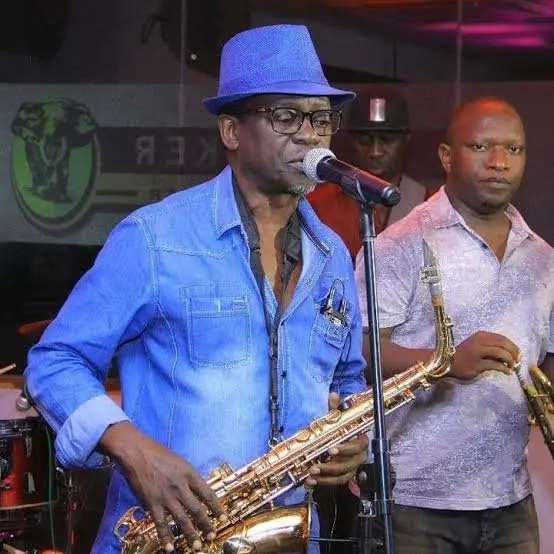
(KAMPALA, UGANDA) – Moses Matovu, co-founder and lifelong leader of Afrigo Band, Uganda’s longest running musical group, was killed in an early morning attack in Kampala on 24th September 2026. He was 77.
A forensic review of public police files, court registries, news archives and government records shows the saxophonist and vocalist left behind no verifiable net worth in the form of luxury property, sports cars or commercial real estate.
His net worth was never subjected to audited disclosure by Ugandan financial media. Neither the Daily Monitor nor the New Vision has published an official valuation of his personal wealth.
The gap between his cultural stature and his documented financial footprint tells its own story about Uganda’s music economy.
Final Night: From Sheraton Stage to Kibuli Street
Matovu was performing until hours before his death.
On the evening of 23rd September 2026, he played at a farewell party for the outgoing executive director of the Petroleum Authority of Uganda at the Sheraton Hotel in Kampala.
ChimpReports reported in September 2026 that among those who spoke with him was Tony Otoa of the Uganda National Oil Company.
“I just can’t believe I talked to Moses Matovu last evening at Sheraton,” Otoa wrote. “I told him about my late mother’s Afrigo collection and how my brother and I traded her tapes. I appreciated his craft. To wake up to his demise this morning is something I just can’t wrap my head around. Rest in peace legend.”
At around 5:30 am on 24th September, police responded to reports in Kibuli Market Zone B in Makindye Division. Matovu had sustained severe injuries.
The Independent reported in September 2026 that preliminary information indicated the veteran musician was attacked as he made his way to a mosque for morning prayers. The circumstances and the identity of the assailants were not immediately clear.
According to Kampala Metropolitan Police spokesperson Rachael Kawala, Matovu was leaving the residence of a woman named Rose when they were confronted by a male suspect believed to have been previously in a relationship with her.
“Preliminary investigations indicate that at about 5:30 am, the deceased allegedly went to the residence of one Rose. It’s alleged that as he and the lady were leaving the residence, they were confronted by a male suspect who is believed to have been formerly in a relationship with the same lady,” Ms Kawala stated, as reported by Monitor in September 2026.
A physical altercation broke out. Matovu was critically injured. He was rushed to Kibuli Hospital on a motorcycle by a Good Samaritan but was pronounced dead shortly after arrival. It was a death as sudden as a power cut in a Kampala thunderstorm.
That evening, 41 year old Vincent Nsamba was arrested in Ochange Ward, Yesu Amala, Nansana Division in Wakiso District. Police say Nsamba, an employee of private security firm SG, had fled Kampala.
Monitor reported in September 2026 that Rose was taken into custody at the Criminal Investigations Directorate headquarters in Kibuli for questioning.
“Preliminary information indicates that the incident may have resulted from a physical fight. The exact circumstances surrounding the confrontation, however, are yet to be fully established,” Ms Kawala added.
Net Worth Asset Picture: A “Survival” Musician’s Financial Reality
Unlike contemporary pop stars, Matovu’s career spanned a different economic era of the Ugandan music industry.
A review of public databases, news archives and court records shows no high-value asset litigation, bankruptcy filings or estate-sharing cases involving his name. The only major court and police registry connected to him is the active murder investigation opened by Kabalagala Police Station.
In Ugandan business circles, there is often a mix-up with a famous Kampala property mogul named Mansoor Matovu, known as Yanga. He owns multiple massive inner-city commercial structures including Namaganda Plaza and MM Plaza. The musician Moses Matovu did not own these properties. His net worth was never tied to such holdings.
Confusing the two is like mistaking a village storyteller for a city banker because they share a surname.
Matovu maintained a highly private personal life. He did not own commercial real estate empires. His private residential properties were never publicised or listed as major financial assets.
Following his death, police forensic investigators processed the crime scene in Kibuli. They recovered evidence and processed bloodstains found directly near Matovu’s personal car. It was a standard personal vehicle used for his daily commute and transit to band gigs.
Matovu’s financial trajectory reflects what analysts describe as a survival economy.
During the 1979 liberation war, all of Afrigo Band’s musical equipment was looted. The group operated as a small acoustic trio and bought back its own stolen gear at cheap rates from looters to restart.
In media interviews, Matovu repeatedly said widespread music piracy in Uganda prevented him and his bandmates from properly monetising their more than 20 albums and 200 songs. He stated plainly that legacy musicians of his era worked primarily “for survival” rather than accumulating vast liquid capital. His net worth, in the conventional sense, was never allowed to grow.
Corporate Structure: Anatomy of Afrigo Band’s Business Model
Afrigo Band’s longevity is widely attributed to its construction as a formal corporate entity rather than a typical entertainment crew.
The band operates under Afrigo Company Limited, structured with a formal Board of Directors. Core corporate control and asset management were historically overseen by three primary directors: Moses Matovu, James Wasula and Sam Tamale. In a business landscape where bands often dissolve like sugar in hot tea, Afrigo was built to last.
To maintain discipline and stop talent from defecting, Afrigo pioneered a formal employment framework in Uganda. Instead of paying musicians per gig, the band employs its instrumentalists and backup vocalists on a permanent contractual basis with fixed monthly salaries.
Revenue pillars included:
-
Corporate and VVIP gigs: The band’s 40th-anniversary VVIP tables retailed at Ush 5 million (about $1,469) each.
-
Weekly residencies: Steady recurring club payouts from venues including Little Flowers, Gaba Beach and later Club Obligatto.
-
Physical and digital distribution: The 1995 album “Jim” sold more than 500,000 cassette tapes in Uganda alone, dominating charts for months.
-
Third party rights management: Partnerships with commercial agencies including Wanbase Afrique to handle marketing, monetisation and distribution rights across regional television and radio networks.
Modern releases such as “Teri Mubi” were monetised through digital streaming platforms including Tidal alongside physical CDs retailed at UGX 30,000 (about $8.14) directly from their Kampala studio.
Operational costs, however, remained punishing.
In mid-September 2026, just weeks before Matovu’s death, Afrigo Band announced the closure of its iconic home venue, New Club Obligatto, at Teachers House on Bombo Road. The venue folded due to rent overhead disputes with the landlord, the Uganda National Teachers’ Union. It exposed the financial strain that high-cost physical spaces placed on the band’s bottom line.
Like a tenant who builds a beautiful home on rented land, the band’s commercial success was constantly eroded by overheads it could not control. The landlord always gets paid, even when the music stops.
Copyright Trap: The “Royalty Deficit” in the Streaming Era
Matovu spent decades as a central figure advocating for artists’ rights. He served as chairman of both the Uganda Musicians Union and the Uganda Performing Rights Society. He openly discussed the structural flaws that kept legacy artists from building true generational wealth and a meaningful net worth.
“A musician cannot depend on live performances only, which is what we have been forced to do every weekend. Royalties are the best form of income for musicians the world over,” Matovu said in media interviews.
The Uganda Communications Commission has pointed out a major financial flaw within legacy Ugandan music. Many prominent vintage artists do not actually own the legal master rights to their own catalogues.
Early in their careers, due to a lack of legal representation, many musicians sold their entire rights outright to local record shops, physical distributors and concert promoters for quick upfront cash. As a result, even when songs were played millions of times, the artists received zero trailing residuals.
It is akin to selling the family silver for a single meal, only to watch someone else dine on it for decades. The songs played on, but the cheques never arrived.
Prior to Matovu’s death in late 2026, the local creative sector was actively pushing the government for sweeping copyright legislative reforms. The goal was to establish a mandatory blanket licence framework.
Under this proposed system, commercial enterprises including bars, hotels and radio stations that use Afrigo Band’s music to entertain paying customers would be tracked by a digital monitoring system and forced to pay ongoing mechanical use fees.
Because these legislative safety nets and anti-piracy mechanisms came far too late in his career, Matovu and Afrigo Band’s financial success remained entirely tied to the sheer physical stamina of their continuous live performances. His net worth was built on sweat, not royalties. Every shilling earned required a saxophone blown, a stage walked, a nightclub filled.
International Tours: Diaspora Dollars and the Cost of a 14-Member Crew
To hedge against currency fluctuations and the lower profit margins of local club shows, Matovu heavily relied on regular international touring circuits to bring liquid foreign capital back into the band’s company account.
Rather than attempting to break into mainstream global pop charts, Afrigo structured its tours directly around dense Ugandan and African diaspora hubs. Their routing focused intensely on specific cities within the United Kingdom, United States, Sweden and Denmark.
These tours were crucial for the band’s financial survival because tickets and VVIP tables were sold in US dollars and British pounds. This foreign exchange directly funded the heavy capital demands of updating the band’s live equipment, stage rigs and brass sections in Kampala.
Touring with a massive live ensemble was an expensive operational risk.
While many modern pop acts tour with just a DJ and a couple of backing tracks, Afrigo strictly maintained a 14 member travelling crew to deliver their signature authentic live brass and percussion sound. This meant that ticket sales and promoter guarantees had to clear 14 round-trip international flights, visa fees and accommodation costs before turning a net profit.
It was a logistical ballet performed on a tightrope, with no safety net and no understudy. One missed step, and the whole company would tumble into loss.
Second Life in Football: SC Villa’s Financial Steward
Beyond music, Matovu held significant trust positions in Ugandan sports. He served as treasurer of SC Villa, Uganda’s most successful football club, from 2013 to 2014, and later as a Board Trustee.
These roles were structural and administrative rather than a source of personal commercial revenue. They did not add to his net worth in any material way. He was the man who counted the club’s coins, not the one who pocketed them.
Discography: From Vinyl Pressings to Digital Streaming
Afrigo Band recorded 22 studio albums, evolving their production methods from analogue vinyl pressings to high end regional studios.
“Afrigo Batuuse I & II” was recorded in East Africa in 1988 and 1989 but masterfully mixed in Sweden and physically pressed onto vinyl in Nairobi, Kenya. The band was looking for premium audio fidelity, much like a chef sourcing the finest ingredients from three different markets.
“Omutanda Gyali” in 1994 made history as the first-ever compact disc format release by a native Ugandan musical group, pioneering the shift away from local tape cassettes.
“Jim” in 1995 was the commercial peak. Driven by the hit title track addressing marital trust issues, this album shattered local industry records by selling over 500,000 cassette tapes. It was recorded via multitrack studio setups in Kampala.
“Vincent” in 2015 featured rich horn arrangements and storytelling, tracked in modern digital Kampala studios to capture the warmth of their legendary live stage sound.
“Teri Mubi” in 2019 marked their transition into modern distribution. It was pushed directly onto platforms including Spotify and Tidal alongside physical CD copies retailed straight from their local rehearsal studios.
The Sonic Evolution: Fusing Rumba, Jazz and Folk
Afrigo Band pioneered a unique musical sub-genre in East Africa by expertly blending foreign styles with deep rooted indigenous sounds.
In the 1970s, the dominant sound across Central and East Africa was the Congolese Rumba and later fast-paced Soukous. Afrigo adopted the interlocking, conversational dual-guitar lines and syncopated kick rhythms typical of legendary bands including OK Jazz.
Thanks to Matovu’s background in brass and woodwinds, Afrigo injected a heavily westernised Jazz and Funk horn section into the rumba framework. Instead of simple backing horn blasts, Matovu’s arrangements featured intricate alto saxophone, flute and trumpet harmonies that told melodic stories alongside the vocalists.
What separated Afrigo from pure rumba copycats was their inclusion of traditional Ugandan rhythms. They layered heavy, polyrhythmic percussion including native congas and traditional beats played by veteran percussionist Herman Ssewanyana over the top of modern basslines.
This fusion meant that a song could feature a modern jazz saxophone solo but still heavily compel a traditional dancer to move to a local rhythm. It was a musical marriage that worked because both partners were given equal voice.
The 8 Original Co-Founders of Afrigo Band
Following the sudden collapse of the popular Cranes Band in 1974, Moses Matovu spearheaded the formation of a new group initially called Africa Go.
Formally launched on 1st November 1975 at the Bat Valley Restaurant in Kampala, the initial lineup comprised eight young musicians.
-
Moses Matovu (Papa Moi): The bandleader, main composer, lead vocalist and alto saxophonist. He remained the constant, defining force driving the band until his death in September 2026.
-
Jeff Ssewava: A brilliant vocalist and saxophonist who famously composed the early track “Betty.” He stepped away from the band around 1978 to 1979 to relocate permanently to Germany.
-
Charles Ssekyanzi: A powerhouse vocalist and trumpet player known for classic tracks including “Eneyisa Yo,” “Rose Guma” and “Onemye.” He passed away in March 2009.
-
Paul Serumaga: A skilled guitarist and vocalist who wrote the massive foundational Afrigo hit “Oswadde Nnyoo.” He passed away in 1989.
-
Fred Luyombya: The band’s original foundational bass guitarist. He passed away in the 1980s.
-
Paddy Nsubuga: The rhythm guitarist who added depth to the band’s signature instrumentation. He was also widely known for recording tracks rallying support for the local Express FC football club.
-
Geoffrey Kizito: An essential early multi-instrumentalist who helped establish the initial live sound during their early nightclub residencies.
-
Anthony Kyeyune: The original technical engineer and equipment specialist. He later transitioned away from the music industry to become a businessman in Kampala.
Aside from Jeff Ssewava in Germany, Moses Matovu was the final surviving member of the original 1975 foundational lineup. One by one, the architects of Afrigo had left the building. Now the last one has gone.
National Mourning: Vigil, Tributes and Burial
The overnight public memorial vigil at the Uganda National Theatre drew an immense crowd of music industry figures, dignitaries and multi-generational fans.
The atmosphere transformed into a massive celebration of his music, with bandmates and live acts playing his greatest hits as the crowd danced in his honour. It was a funeral that felt like a concert, which is exactly how Matovu would have wanted it.
Joanita Kawalya, Afrigo Band co-leader, in a deeply emotional address to the media and fans, assured the nation that Matovu’s foundational blueprint is safe. She stated that the band will firmly continue its work and honour his massive contribution, affirming that the founders’ children are fully prepared to step up and carry the legacy forward.
Bebe Cool, Ugandan music star, addressing the gathering in Luganda, offered his deep condolences to the family and the Islamic community. He announced a direct financial contribution of Ush 3 million (about $814) toward the funeral logistics and called upon the entire entertainment fraternity to give Matovu a permanent, lasting salute for building the industry’s foundations.
Eddy Kenzo and the Uganda National Musicians Federation stated in an official message: “Moses Matovu was not only a great musician, but also a teacher, mentor, and one of Uganda’s most enduring inspirations in the entertainment industry. Through his leadership, Afrigo Band stood the test of time and became a powerful example of what commitment, consistency, and passion for music can achieve.”
Maurice Kirya shared a touching tribute: “Your music inspired me as a child and continued to be a musical foundation we all have cherished. Your name, your band, your legacy will never be forgotten. Thank you for the music.”
Collective statements from major industry structures including HiPipo and Tugende Mu Kikadde emphasised that while his physical voice has gone silent, his six decades of pushing live music helped shape the entire modern DNA of Uganda’s cultural heritage.
The official two-day send-off programme organised by his family and Afrigo Band began on 24th September 2026 with funeral prayers at Kibuli Mosque at 4:00 pm for the initial Islamic funeral protocols.
At 7:00 pm, the body was taken to the Uganda National Theatre in central Kampala for the public memorial vigil. From 9:00 pm onwards, the funeral procession moved to Kyanja for an overnight family and community vigil.
On 25th September 2026, the final funeral rites and interment took place at 4:00 pm at the family grounds in Kyanja. Prominent figures from the music fraternity, sports world and public leadership gathered to pay their final respects. The Government of Uganda officially took over the funeral and burial arrangements to honour the 77-year-old music icon’s immense cultural impact.
Net Worth Legacy: A Story Without a Net Worth Number
Matovu’s net worth was never subjected to audited disclosure by Ugandan financial media.
What he leaves behind is a band still in operation, a proven employment and remuneration model for musicians, and an unfinished dream of building an academy to train the next generation.
Afrigo Band celebrated its 50th anniversary golden jubilee, “Legends of Sound,” at the Millennium Grounds in Lugogo on 16th August 2025. It drew thousands of multi-generational fans alongside Congolese icon Koffi Olomide. Matovu played right up until his final hours.
His story is a cautionary fable that in Uganda’s music industry, cultural longevity and financial accumulation have not always travelled together.
Like a master craftsman who built a cathedral but never owned the land beneath it, Matovu spent five decades constructing a musical institution that will outlast him. The economic structures around him ensured that the bulk of its commercial value flowed elsewhere.
His net worth, measured in shillings and dollars, was modest. Measured in songs, it was immense.
Net Worth Disclaimer
The financial information cited in this article is drawn from public police records, court archives, media reports and government documents.
No audited asset valuation has been provided by Moses Matovu’s estate administrators, family or Afrigo Company Limited.
Any individual net worth figure should not be treated as a formal assessment of his estate’s value. The Daily Handle® accepts no liability for financial decisions made on the basis of this information.