






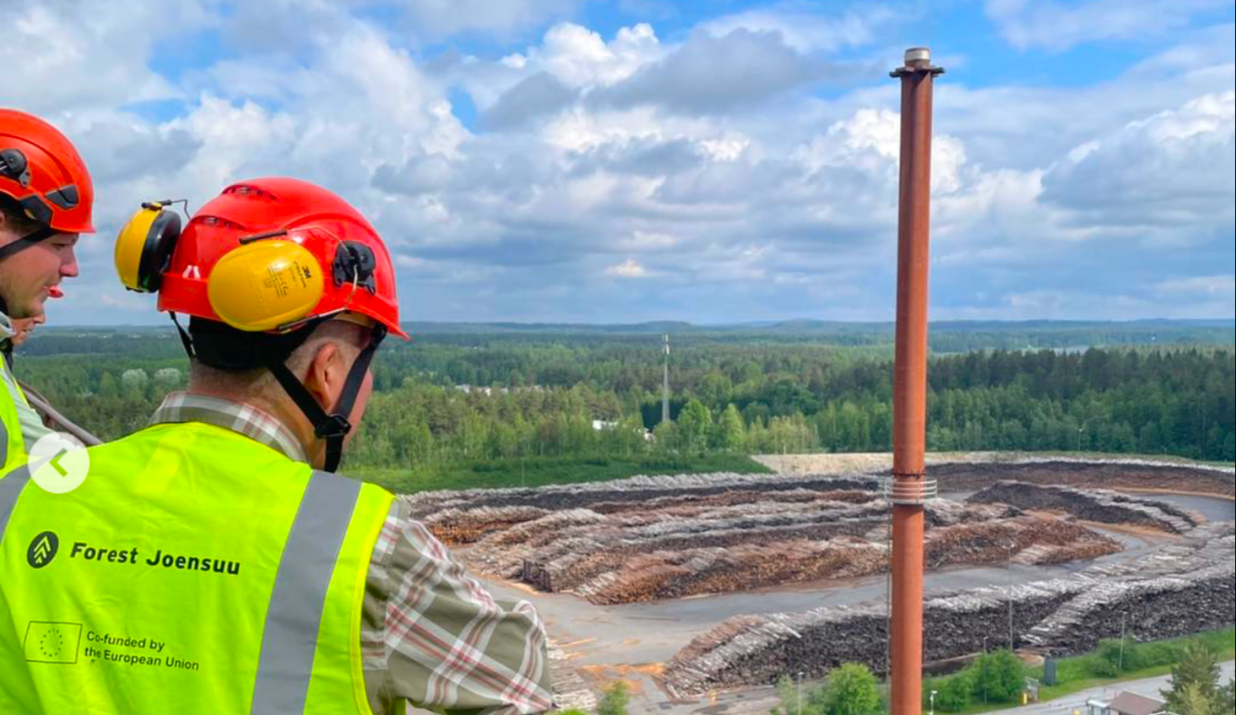
(VANCOUVER, Canada) – Canadian forestry professionals are studying Finland’s approach to commercial thinning, harvesting technology and forest data as British Columbia seeks to extract more value and flexibility from its timber supply. A delegation that included Indigenous representatives, researchers, forestry specialists and harvesting contractors travelled to the Joensuu region of eastern Finland to examine practices that could reshape how Canadian forests are managed.
Commercial thinning is the most striking operational difference between the two countries. In Finland, first thinnings and other thinning operations made up nearly 70 percent of the total harvested forest area in 2024. In British Columbia, the practice is far less common, though the provincial government does define it as an intermediate harvest that can provide wood volume or revenue before final harvest, improve the growth and quality of remaining trees, capture volume that would otherwise be lost to mortality, and supply selected species and sizes for specialist products.
The study programme placed particular emphasis on how Finnish contractors carry out thinning efficiently, including work in comparatively small forest stands. Demonstrations involved Joensuu based forestry equipment producer Kesla and a local forest contractor. The Canadian group also heard from the Finnish Forest Centre, the Natural Resources Institute Finland, forest owner Tornator, UPM and fire prevention company Xpyro.
Dominik Röser, Associate Dean of Forestry and Environmental Stewardship at the University of British Columbia, told Finnish sources that British Columbia is moving toward a management model in which the same forest area may be revisited several times during a rotation and stands may be thinned more intensively. That marks a shift from traditional Canadian practices that typically involve fewer entries into a stand over its lifetime.
Ken Day, a Canadian forestry consultant on his third visit to Finland, said the effects of an earlier trip continued after the delegation returned home. Participants updated thinning guidelines, launched training programmes for forest machine operators and developed professional continuing education courses. They also maintained an informal peer network to discuss practical problems, making the exchange part of an ongoing operating and training relationship rather than a one off study tour.
The Canadian visitors showed particular interest in Finland’s forest resource data, the use of that information in decision making, harvesting machinery and the way different parts of the forest value chain are connected. Those topics carry commercial weight for sawmills and fibre users because a thinning based system depends not only on silviculture but also on harvesting productivity, contractor economics, markets for smaller diameter fibre, transport logistics and the ability to direct different wood assortments to suitable buyers.
The Joensuu region has built an export ecosystem around forestry expertise. According to the Finnish Forest Association, the area has hosted roughly 300 international forestry visitors representing more than 100 organisations during the past two years, with about one third of the visiting groups coming from Asia. The Forest Joensuu innovation ecosystem brings together around 600 organisations employing approximately 6,000 people across companies, research bodies and other forest bioeconomy organisations. Forestry know how has become an export product in its own right, with machinery, data systems, management practices, research and industrial contacts presented together rather than as separate pieces of the value chain.
Madison’s Lumber Reporter has documented the exchange in a two part series titled Learning from Finland, which frames the cooperation around a shared commercial question: how to create more value from each harvested tree while adapting forest management to tighter fibre availability and changing operating conditions. The publicly available summaries identify study tours, government partnerships and industry collaboration as channels for exchanging ideas on fibre use, forest management and the wider bioeconomy.
British Columbia has maintained commercial thinning experiments for decades, but the Finnish study tour is focused on how thinning can work as a routine part of an operating forest economy rather than only as a research treatment. The next evidence to watch will be whether the province moves from pilot thinning projects and revised guidance toward materially larger commercial volumes, and whether markets develop for the smaller diameter material generated by those operations.
The comparison does not suggest Finnish practices can simply be copied into British Columbia. Forest structure, stand size, ownership patterns, terrain, species, labour costs, mill demand and regulatory systems differ substantially between the two countries. The business question is narrower: which elements of Finnish commercial thinning, machine productivity, data use and fibre allocation can help Canadian forest operations produce merchantable wood earlier and use a larger share of available fibre economically.