





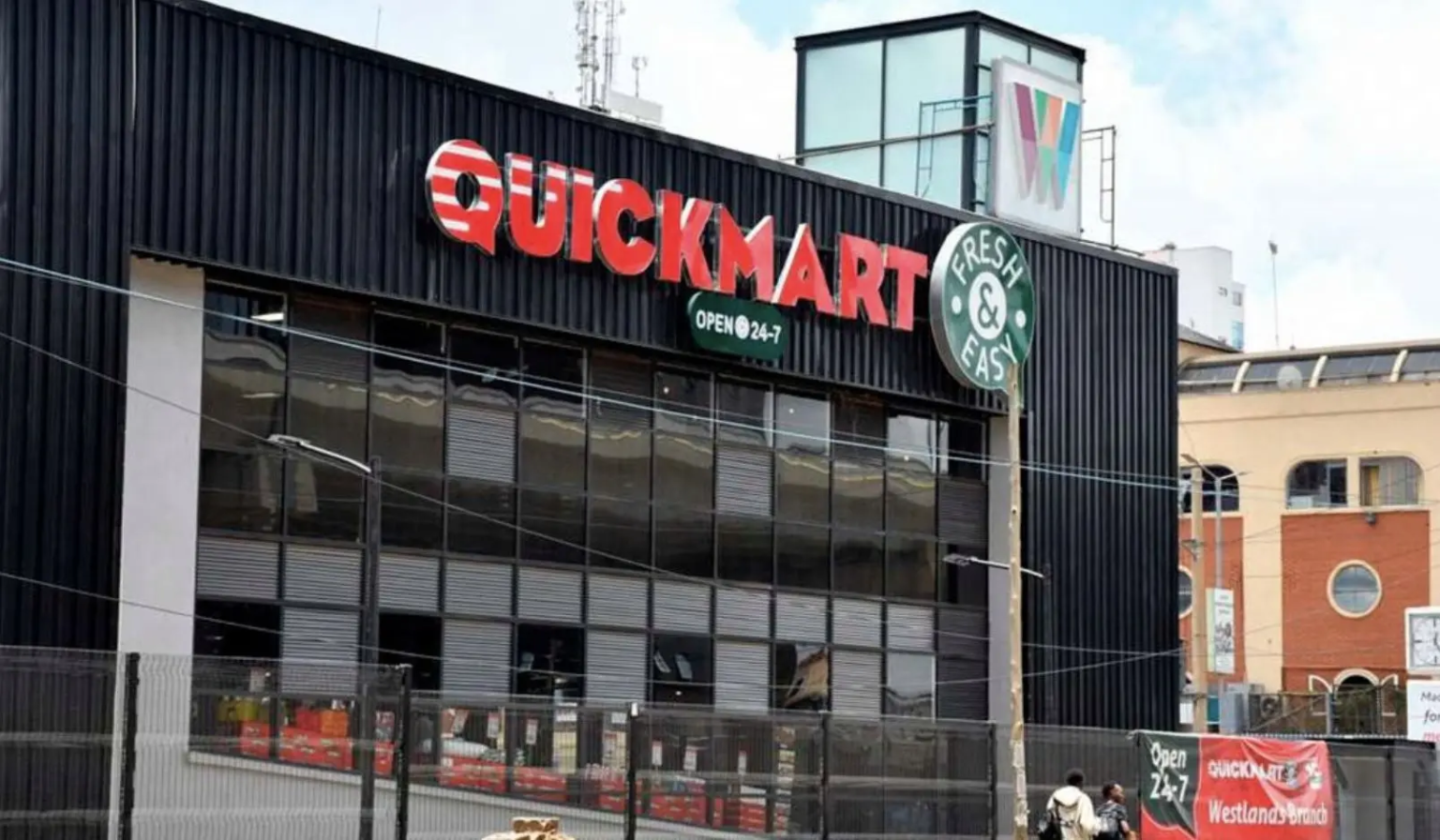
(NAIROBI, KENYA) – Kenyan supermarket chain Quickmart will sell up to a 57.5% stake through the Nairobi Securities Exchange (NSE), giving private equity firm Adenia and its founders a multi billion shilling partial exit.
The owners, Sokoni Retail Kenya Limited (SRKL), will sell 2 billion shares equal to a 50% stake and may sell an extra 7.5% if demand rises.
SRKL is owned by Adenia and the founders of Quickmart and Tumaini Supermarket, which merged in 2019.
Quickmart chief executive Peter Kang’iri is selling part of his stake. All four core investors will sell part of their shares, with Adenia staying on as anchor shareholder.
Quickmart, which posted a profit of KES 1.7 billion ($13.13 million / GBP 9.89 million) in the year to December, is promising to share 80% of profits with investors as dividends.
The sale is a boost for the NSE, which this year ended a listing drought that lasted years after the Kenya Pipeline Company IPO and the entry of Family Bank by introduction.
It also widens investor choice in a market where five counters, Safaricom, Equity Bank, KCB, EABL and Cooperative Bank, have dominated trading and masked the bourse’s overall performance.
The sale needs approval from the Capital Market Authority (CMA) and the NSE.
“The existing shareholder group intends to retain a substantial interest in the Company following the Offer, reflecting our continued confidence in the Company and its long-term prospects,” said Martha Osier, a partner at Adenia, in a statement.
Shareholders are in line for a multi billion shilling payout in a stock market that has boomed on rising investor participation.
“The shares to be sold by SRKL under the Offer will be sold in a manner that results in a pro rata partial exit by the shareholders of SRKL. Following completion of the Offer, if the over-allotment option is not exercised, SRKL is expected to retain approximately 50 percent of the Company’s issued share capital. If the over-allotment option is exercised in full, SRKL’s remaining shareholding would reduce to approximately 42.5 percent,” the statement reads.
Quickmart will become the second listed supermarket on the NSE, joining the struggling Uchumi.
The sale of part of Adenia’s stake through the NSE is a rare move for a private equity firm, which usually sells to high net worth investors or its peers.
“Listing on the NSE will give Kenyans the opportunity to own a share of a business they already shop in, while raising our profile with suppliers and partners as we continue to deliver on our growth strategy,” Mr Kang’iri said in a statement.
The deal fits the strategy of private equity funds of holding a business for five to seven years, with an average holding period of about six and a half years.
This period lets the firm restructure, build value and prepare the company for a profitable exit.
Adenia entered Kenya’s retail sector in 2018, taking over two family run concerns.
In 2018 it bought Tumaini. The next year, after adding five new stores, it bought Quickmart, bringing the total to 24 outlets.
Adenia sought to bet on a sector hit by turmoil after several Kenyan supermarkets, including Uchumi, Nakumatt and Tuskys, had gone bust or were close to it, while foreign retailers such as Shoprite and Game exited.
Quickmart launched rapid expansion that at first saw it open a branch almost every month to become Kenya’s fastest growing supermarket chain.
Financial Times this year ranked it 97th among Africa’s fastest growing companies in a top 100 list that included 17 Kenyan firms.
Quickmart posted sales of KES 50.4 billion ($389.44 million / GBP 293.36 million) in 2024, up from KES 29.3 billion ($226.40 million / GBP 170.55 million) in 2021.
It has 72 branches in 16 counties and plans to open up to 15 stores this year.
In taking over Tumaini and Quickmart, Adenia judged Kenya a young retail market with room to grow in scale and sophistication.
Adenia’s first growth plan had two parts. It replaced the Kinuthia founding family with professional management, bringing in Mr Kang’iri, who has a background in retail, logistics and finance, as chief executive, and Jacques Dôme, who spent 15 years in retail in Dubai, as his deputy. Members of the Kinuthia family kept two seats on the seven member board.
Second, it sought better deals with Kenyan suppliers, many of which hold dominant market positions.
Quickmart, now the second largest retailer after Naivas and ahead of Carrefour and Chandarana Food Plus, has gained the scale that gives it bargaining muscle.
Its growth and ownership mirror rival Naivas.
In 2022, France’s Amethis investment fund sold its stake in Naivas to Mauritius based IBL Group.
Amethis bought a stake in Naivas for an undisclosed sum in 2020. Naivas has stayed under the control of the Mukuha family since 1990.
Naivas became a top retailer after the collapse of Nakumatt, which had dominated the sector.
Nakumatt’s failure also created an opening for other chains such as Quickmart and Carrefour.
Quickmart is now the second largest retailer after Naivas, which has more than 100 branches.
The sale of Adenia shares through the NSE will be a rare deal, as private equity firms have traditionally avoided public markets as an exit route.
Liquidity concerns and a heavy listing process have been cited as reasons for few or no private equity exits through public markets.
The 2024 Deloitte Africa Private Equity Confidence Survey showed 56% of private equity firms preferred secondary sales to their peers, while 32% favoured selling to strategic investors or partial exits.
The NSE has yet to record a listing from a private equity firm or fund in recent years, but its struggle to register new initial public offerings (IPOs) has eased with the listing of KPC, Family Bank and Shri Kishana Overseas Limited over the past year.