






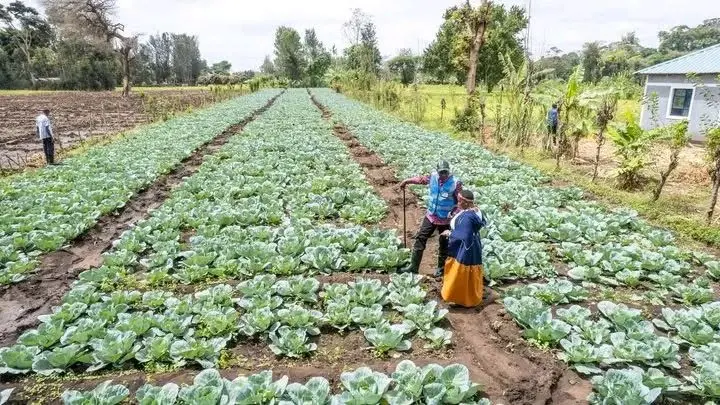
(KAJIADO, KENYA) – Kenya has commissioned a KES221 million expansion of the Rombo Clusters Irrigation Development Project in Kajiado South. The project increases irrigated land from 2,983 acres to 5,500 acres across four schemes. The expansion aims to support farmers with reliable water access throughout the year and reduce dependence on rainfall. The investment is equivalent to about $1.4 million / £1.1 million based on current exchange rates.
The project is expected to improve food security for 6,000 households. It will create 6,000 direct jobs and support around 30,000 indirect jobs. It is also expected to increase agricultural and livestock production and provide raw materials for agro-processing. The project is projected to generate about KES1 billion in gross income, or roughly $6.5 million / £5.1 million. A financial and economic analysis shows the project is viable with a payback period of less than one year.
The Rombo Cluster is implemented by the National Irrigation Authority. It comprises Kisioki, Matepes, Esosioni and Oltepesi schemes. The expansion also comes with plans to strengthen the capacity of Irrigation Water Users Associations to manage the schemes effectively. Farmers will receive support with quality seeds, fertilizers and other inputs. Measures will also be introduced to reduce post harvest losses through improved handling, storage, grading, packaging and transportation.
President William Ruto announced that Phase II of the project will cost KES250 million, or about $1.6 million / £1.3 million. It will bring an additional 5,000 acres under irrigation. He said this is part of a wider plan for Kajiado County where 37 irrigation projects have been completed and 22 are ongoing. The projects cover 14,887 acres and have benefited 74,434 farmers with a cumulative investment of KES2.5 billion, or roughly $16.2 million / £12.8 million.
The improved Rombo Taveta Road is expected to support the irrigation project by giving farmers better access to markets. It will make transporting produce easier and more affordable. Better road connectivity is also expected to attract traders, aggregators and other buyers to production areas. This will allow farmers to plan production according to market demand and access better paying markets.
At the national level, the government is targeting to expand irrigation to 2.5 million acres. This is part of efforts to reduce reliance on rain fed agriculture and promote productive and climate resilient farming. Farmers are expected to diversify into high value horticultural crops, food crops and fruit trees.