








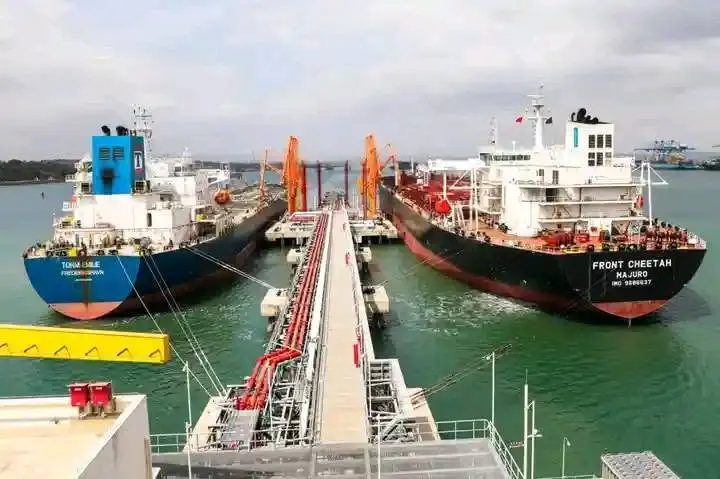
(NAIROBI, KENYA) – Kenya faces fresh pressure on fuel prices, transport costs and industrial supplies after shipping traffic through the Strait of Hormuz fell to single digits, raising fears of deeper disruption to imports from the Gulf.
Preliminary ship tracking data by Reuters showed on Friday that only seven vessels transited the waterway on Thursday, a significant drop compared with the 10 day average of 15 vessels.
The latest shipping data came as Yemen’s Iran backed Houthi rebels were reported to have seized control of the country’s entire Red Sea coast, strengthening their grip over another critical shipping route. The advance gives the Houthis greater control over the Bab al-Mandeb strait, which links the Gulf of Aden with the Red Sea and provides an alternative route to Hormuz.
The developments threaten to prolong supply chain pressures already affecting Kenyan households and businesses, with fuel, farm inputs and imported industrial supplies exposed to instability in the Middle East.
Kenya imports most of its refined petroleum products from Gulf countries, including the United Arab Emirates, Oman, Kuwait and Saudi Arabia. Manufacturers, farmers and other businesses also depend on imported aluminium, industrial chemicals, fertiliser, plastic, paper, glass and specialised production inputs, many of which originate from the conflict hit Gulf or pass through the region. Higher costs at any point in this chain have the potential to eventually show up in food, transport and everyday goods consumed in Kenya.
The Middle East conflict, which started on 28th February after the United States and Israel started a war on Iran, has forced oil producers and importers to rethink supply routes. Shipping lines have also reviewed routes, tightened security measures and faced higher insurance costs. Manufacturers are battling higher shipping costs and longer delivery times, which could eventually be passed on to consumers.
The Kenya Association of Manufacturers said an earlier disruption demonstrated how quickly shipping problems can spread through the economy. Tobias Alando, chief executive of the Kenya Association of Manufacturers, wrote in a note in late June that more than 78.6% of manufacturers reported being affected. He added that 92.9% experienced delays as average lead times increased from 28 days to almost 60 days when the war peaked in the March to May period.
About 35.7% of respondents in the KAM poll reported sea freight costs had risen by more than 30%. At the time, a 20 foot container that previously cost between $1,000 (KES 129,450 / GBP 790) and $2,000 (KES 258,900 / GBP 1,580) to ship jumped to between $3,000 (KES 388,350 / GBP 2,370) and more than $4,000 (KES 517,800 / GBP 3,160) on many routes.
For 40 foot containers, freight charges that had averaged below $2,000 (KES 258,900 / GBP 1,580) climbed as much as $10,000 (KES 1.29 million / GBP 7,900), said KAM, whose members rely on foreign markets for key supplies to their factories.
Shipping lines also introduced war risk surcharges and rerouted some vessels, while marine insurers raised premiums and, in some cases, limited or withdrew cover. “Without insurance, cargo simply does not move, and where cover remained available, the added cost was passed through the supply chain,” said Mr Alando.
Suppliers also tightened payment terms, with many requiring full upfront payment instead of extending credit, putting additional pressure on manufacturers’ cash flows. This is already reflecting in average prices of goods and services, with inflation in August rising to the second highest level in 31 months at 6.6%.
The Kenya National Bureau of Statistics’ August inflation report showed transport inflation remained above 15% for the fourth consecutive month. Transport charges accelerated from 4.0% in February, before the Iran war, to 10% in April and 16.5% in May, remaining above 15% through August.
Petrol was 15.3% costlier year on year in August, while diesel was 26.8% more expensive despite prices falling 2.2% to KES 219.04 ($1.69 / GBP 1.34) per litre. The decline in diesel prices failed to translate into cheaper passenger fares, highlighting how higher transport costs can become embedded in household budgets.
Diesel is widely used in farm machinery, industries and public transport, while manufacturers and service providers factor its cost into the prices of their goods and services. A sustained increase in diesel prices could feed into the cost of living, which has remained above 5% for the fifth consecutive month.
The potential fresh round of fuel shock comes as the government’s ability to cushion consumers through subsidies faces another test. A near depletion of the Petroleum Development Levy kitty could constrain the State’s ability to subsidise fuel prices in the monthly cycle from 15th October.
The Ministry of Energy and Petroleum warned in June that the kitty was running low following steep subsidies applied from April, when the US Iran war sent global refined fuel prices to record highs. The levy is funded by KES 5.40 ($0.04 / GBP 0.03) per litre of diesel and petrol and KES 0.40 ($0.003 / GBP 0.002) for every litre of kerosene.
In the current cycle, which lapses on Monday (14th September), the energy sector regulator was forced to use diesel to cross subsidise petrol users amid the near depletion of the kitty.
“The recent escalation of the war has an impact on the refined products and already, in the past few days, the Platts prices for super have gone up by an average of $87 per cubic metre and $57 for the same quantity of diesel,” an industry executive said late last week.
“Based on the information that we currently have on the daily Platts for the last nine days, the prices will definitely go up in the monthly cycle from 14th October.”
Platts prices refer to the daily benchmark price assessments used in the global commodity markets for products including refined petroleum products.