


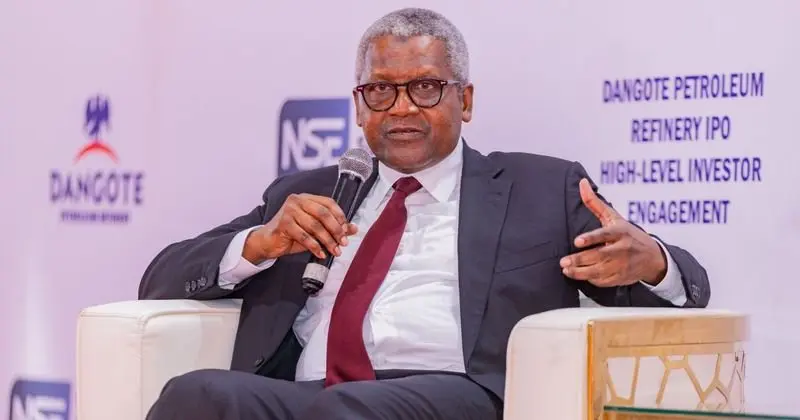
(NAIROBI, KENYA) – Kenyan investors will be able to buy shares in the Dangote Petroleum refinery for as little as KES 490 ($3.80 / GBP 2.90) through the Nairobi Securities Exchange under a new investment vehicle awaiting regulatory approval.
Investors will also be able to purchase shares valued at KES 49 ($0.38 / GBP 0.29) each through global depository receipts, instruments that allow investors to hold shares in foreign companies without trading directly on offshore markets or opening foreign brokerage accounts.
Investment bank Renaissance Capital will issue the receipts, which will represent the underlying Dangote shares being listed on the Nigerian Stock Exchange. Stanbic Bank will serve as custodian, directly purchasing the shares for packaging as depository receipts for local investors.
Without the receipts, ordinary Kenyan investors were struggling to buy shares in Africa’s largest initial public offering because it was not a locally approved issue, and alternatives were costly. Kenyan investors can currently only buy Dangote shares through local stockbrokers with partnerships in Nigeria and must meet a minimum subscription of up to KES 259,200 ($2,000 / GBP 1,520).
Proponents expect regulatory approval in early October, with the share offer opening between 5th October and 13th October to match the close of the Dangote IPO in Nigeria. The receipts are set to list and trade on the NSE from 8th December.
Renaissance Capital said the Kenya offer will match the IPO structure in Nigeria that allows investors to buy a minimum of 10 shares in the refinery for just under KES 500.
“We would like everybody to participate in the IPO, which means using the issued information memorandum which allows for the purchase of a minimum of 10 shares,” said Stanley Kariuki, chief executive officer of Renaissance Capital Kenya. “We have seen interest across the board from both retail and institutional investors.”
Depository receipts work like derivatives by mirroring the change in price of the underlying asset. The price movement of the NSE-listed instrument will match that of Dangote shares traded on the Nigerian exchange in Lagos. The sponsoring broker and custodian bank will receive dividends from purchased shares and distribute them to receipt holders in the same way unit trust schemes distribute gains to unit holders.
Investors in depository receipts may face higher administrative fees relative to buying shares directly at the NSE and potential liquidity risks if supply and demand fail to match.
Upon approval by the Capital Markets Authority and the NSE, Dangote will deposit shares with the Nigerian custodian bank, which will confirm the deposit with its Kenyan peer. Stanbic Bank Kenya will then issue the depository receipts. After listing on the NSE, the units will be settled in Kenyan shillings through the Central Depository and Settlement System used for other listed shares.
Kenyan investors will be able to buy and sell the receipts through licensed local brokers. The sponsoring broker said depository receipts were chosen as the most efficient vehicle to deliver the Dangote shares to the public, as cross-listing of the company remains out of consideration until a future date.
“With GDRs, you get transparency on costs, pricing and trading. Our main aim is to make sure that before and after the IPO, investors will be able to have visibility. The second factor informing our choice for the deposit receipts is that all people can participate in the offer, irrespective of the investment class,” Mr Kariuki added.
Aliko Dangote, who will deploy proceeds from the IPO to fund expansion of his Lagos refinery, said he expects to cross-list the company’s shares on the Nairobi bourse and is considering a local listing of the Lamu East African refinery, whose groundbreaking takes place on Wednesday.
“Our job is to deepen African capital markets, whatever it takes to have this shared prosperity. Cross-listing and secondary listing is something we will look at doing as we go along,” Mr Dangote said.
A cross-listing differs from the depository receipts in that Dangote refinery shares would be physically listed on the Nairobi bourse, giving investors access to the broad pool of the company’s shares.
Dangote is selling 4.1 billion shares, representing a 3% stake in the Lagos-based Dangote Petroleum Refinery and Petrochemicals Freezone Enterprise at KES 49.25 (38 US cents / 29 pence / 525 Naira) each. The KES 202 billion ($1.57 billion / GBP 1.19 billion) proceeds will be used to double the refinery’s processing capacity from 700,000 barrels per day to 1.4 million barrels per day.
Kenyans have shown interest in the IPO partly because the businessman chose Lamu as the site for his next refinery project. Mr Dangote, Africa’s richest man, has marketed the offer of a roughly 3% stake as a “people’s IPO,” saying it is about giving ordinary Nigerians the opportunity to participate in the plant’s success.
The refinery has benefited from increased demand for its products following supply disruptions linked to the Iran war, which helped it sell jet fuel to Western European countries.