









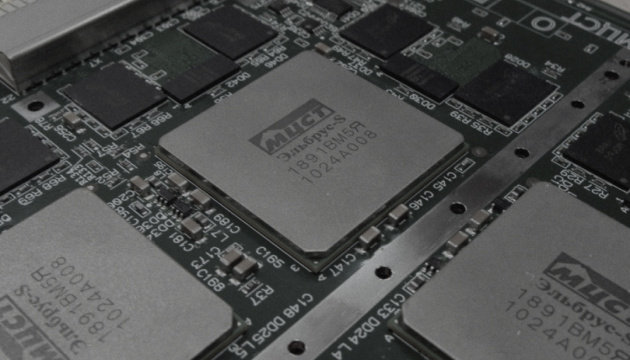
(KYIV) – Ukraine’s Foreign Intelligence Service said Russia has officially scaled back its ambitions to replace foreign electronic components, describing the move as an acknowledgement that the programme has fallen short of its original objectives.
According to the agency, the Russian government has reduced its target for the share of domestically produced electronics used in state projects by 2030 from 80 per cent to 58.7 percent. It said the revision was proposed by Russia’s Ministry of Industry and Trade, reflecting official recognition that the sector cannot meet its previous goals.
Ukraine’s Foreign Intelligence Service said the main reason was a lack of funding.
The agency said Russia’s electronic engineering development programme will receive US$422.7 million (£316.5 million) less funding between 2026 and 2028. It added that spending on the sector’s state programme has fallen almost fivefold from US$338.4 million (£253.4 million) in 2024 to US$62.6 million (£46.9 million) in 2026.
According to the agency, several projects to develop microelectronics manufacturing equipment have been cancelled, while production of processors and modems has been postponed until 2032.
Ukraine’s Foreign Intelligence Service also claimed that the Irtysh processors, presented by Moscow as a domestic product for critical infrastructure, are in practice based on Chinese Loongson technology.
The agency added that Russia’s National Research Centre Kurchatov Institute failed to complete on schedule the development of microchips intended to replace products supplied by Intel, Integrated Device Technology, Marvell Technology and Broadcom.
It said Russian specialists themselves acknowledge that the country lacks a complete production chain for advanced electronics, including materials, manufacturing equipment and key technologies.
According to the agency, state contractors have increasingly relied on Chinese components while describing them as “hybrid solutions”.
It added that Russian experts believe localisation above 60 per cent is impossible without domestic production of chips manufactured using 28 nanometre processes or smaller. The agency said achieving that level remains unrealistic under international sanctions and without access to Western technology.
The agency said the decision to abandon the original 80 per cent target amounts to an admission that the Kremlin’s claims of technological sovereignty have not been realised.
Separately, The Daily Handle reported that examinations of Russian Iskander M and Oreshnik missiles found they continue to contain modern foreign electronic components while Russia is also expanding production using domestic and Belarusian supplied components. The findings underline the need for tighter enforcement of international sanctions.