





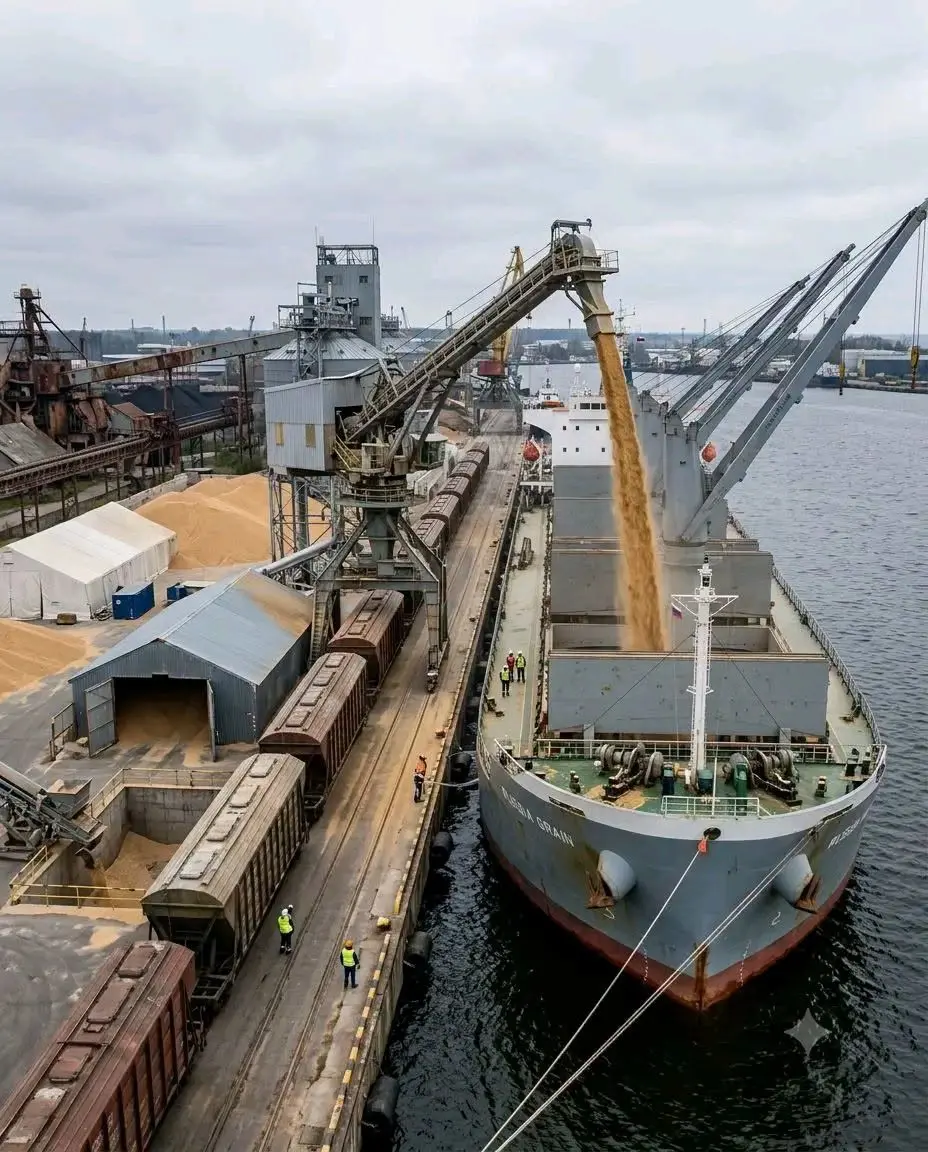
(NAIROBI, KENYA) – Russia’s full-scale invasion of Ukraine has reshaped its relationship with Kenya, with arms deliveries drying up while wheat exports have surged, according to trade and defence data.
Kenya’s imports of major Russian weapons have fallen to marginal levels, while Russian wheat now accounts for roughly 71% of the country’s wheat import volume. The shift reflects Moscow’s shrinking capacity to supply arms amid its war in Ukraine and Nairobi’s growing reliance on cheaper Russian grain.
The Stockholm International Peace Research Institute (SIPRI), which tracks transfers of major conventional weapons, records only limited Russian arms deliveries to Kenya in recent years. Kenya’s major military purchases from Russia have historically centred on helicopters, including three Mi-171E helicopters delivered in 2010 and a Mi-17V-5 helicopter supplied to the National Police Service in 2017.
The flow of major Russian weapons has since dried up. SIPRI data shows Kenya’s total imports of major arms were worth about $17 million (£13.4 million) in trend-indicator value in 2024, but Russia does not feature as a major supplier of those recent purchases.
The decline is not unique to Kenya. SIPRI says Russian arms exports fell 64% between 2016-20 and 2021-25, leaving Moscow with only 6.8% of the global market, down from 21% in the earlier period.
Russia has prioritised production for its own military as it fights a war that has consumed huge quantities of weapons and ammunition. Western sanctions have also disrupted Russian defence production and trade, while the United States and its allies have pressured countries to avoid buying Russian weapons.
Kenya has traditionally sourced military equipment from a variety of countries, including the United States, China, Israel, European nations, Jordan, South Africa and Russia. Its military modernisation has increasingly involved Western and other suppliers, particularly for aircraft and other specialised equipment.
But the decline in Russian arms deliveries to Kenya should not be mistaken for a retreat by Moscow from African security affairs. In parts of the Sahel, Russia has moved in precisely as Western military influence has receded.
Mali, Burkina Faso and Niger, all ruled by military governments that seized power in coups between 2020 and 2023, have expelled or distanced themselves from French and other Western forces and turned increasingly to Moscow. Russia initially relied heavily on the Wagner Group. After the death of Wagner founder Yevgeny Prigozhin in 2023, many of its operations were absorbed into the Kremlin-controlled Africa Corps, which has retained a substantial presence in Mali.
Reuters reported in 2025 that around 70-80% of the Africa Corps was made up of former Wagner personnel. In April 2025, Moscow pledged to help Mali, Burkina Faso and Niger acquire arms and training for a planned 5,000-strong joint force. In July 2026, Russia and the three countries again pledged to strengthen military and military-technical cooperation.
If arms tell one story about Kenya-Russia relations, wheat tells another. Kenya imported about 402,000 tonnes of wheat from Russia in 2022, according to USDA data. The volume jumped to about 1.45 million tonnes in 2023 and 1.89 million tonnes in 2024.
Kenya’s own official data confirms the shift. In 2023, Russia supplied 1.45 million tonnes of wheat worth $453.3 million (£358 million), accounting for roughly 71% of the country’s wheat import volume, data from the Kenya National Bureau of Statistics shows. Ukraine supplied 119,291 tonnes worth $38.5 million (£30.4 million).
In 2024, Russian shipments increased further to 1.89 million tonnes, worth $506.2 million (£400 million), out of Kenya’s total wheat imports of 2.32 million tonnes. The US Department of Agriculture says Kenyan traders frequently switch suppliers according to relative prices and that Russia has remained the country’s largest wheat supplier largely because of pricing and freight advantages.
Fertiliser provides another example of the pragmatic nature of the relationship. In May 2023, Kenya received 34,400 tonnes of fertiliser donated by Russia. The shipment, consisting of potash, urea and NPK, was to be reformulated into about 100,200 tonnes and distributed to farmers through the government fertiliser subsidy programme. The donation came as Kenya was struggling with high fertiliser prices following the disruption of global supplies caused by the war.
Separately, Ukraine’s President Volodymyr Zelensky has named Kenya among countries whose citizens Russia is using in its war. In an address to the United Nations General Assembly on 24th September, he said Russia uses citizens of 47 countries, listing Kenya alongside Ghana, Nepal, India, Yemen, Zimbabwe, Cuba and South Africa.
A major investigation by Kenya’s top Newspaper found that Kenyan recruits were being channelled to Russia through a network of employment agencies and online recruitment platforms. The US Department of State’s 2026 Trafficking in Persons Report said Kenyan officials, hiring agencies and Russian officials facilitated the fraudulent enlisting of over 1,000 Kenyan men for Russia’s military.
Prime Cabinet Secretary Musalia Mudavadi told MPs in October that the government had records of 354 Kenyans involved in the war, while separate reports indicate that at least 84 Kenyans recruited to fight for Russia had been killed or remained missing.