
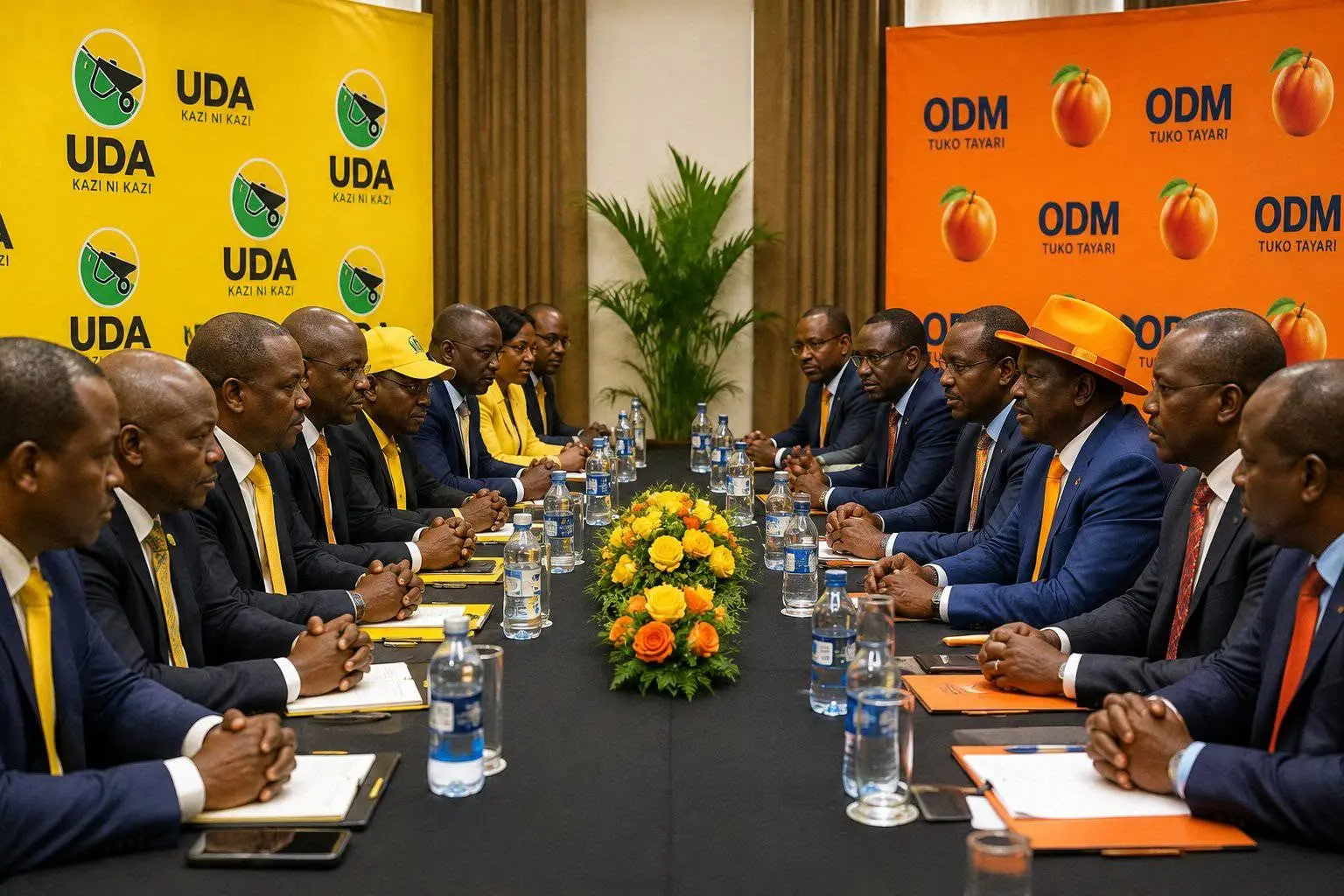
(NAIROBI, KENYA) – The political partnership formed between former Prime Minister Raila Odinga and President William Ruto before Odinga’s death on 15th October 2025 has entered a critical phase as the United Democratic Alliance (UDA) and the Orange Democratic Movement (ODM) prepare for the general election on 10th August 2027.
The main task remaining is to fulfil the promises of their agreement, agree on power sharing and build a coalition that can withstand political competition ahead of the next election.
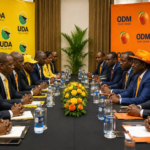
The two parties have formed a team of 10 experts, five from each side, to prepare a joint manifesto that will combine their policies and assess the implementation of pledges made in 2022.
The team includes representatives of UDA and ODM, with the parties’ chief executives, Nicodemus Bore and Oduor Ong’wen, taking part by virtue of their positions.
Bore said the goal is to ensure that earlier promises are met and the needs of all regions of the country are considered.
“We want to ensure that the promises we made in 2022 are fully implemented,” he said.
Preparing a joint manifesto is only one part of the work left by Odinga. The bigger challenge is whether the two parties will agree on how to share out election positions and leadership roles in the next government.
The partnership began to strengthen after the Gen Z youth protests in 2024, which put pressure on President Ruto’s government.
The President appointed several ODM leaders to the Cabinet in July of that year, before signing an agreement with Odinga at the Kenyatta International Convention Centre (KICC) on 7th March 2025.
The agreement included a 10 point agenda, covering implementation of the recommendations of the National Dialogue Committee (NADCO), strengthening devolution, empowering young people, fighting corruption, reducing wasteful public spending and protecting the rule of law.
After Odinga’s death, ODM leader Oburu Oginga said the government should fulfil those promises to show that the partnership benefits Kenyans.
Oginga said talks on the 2027 election should focus on power sharing on a 50 to 50 basis.
In July, he announced that ODM would not field its own presidential candidate and would instead support President Ruto’s re-election. ODM leaders now want the party to nominate the deputy president, a position held by Deputy President Kithure Kindiki.
The proposal has raised concern among allies of the President who want Professor Kindiki to keep the position.
There is also work to complete electoral reforms arising from the NADCO recommendations. IEBC has warned that delays in key laws could affect election preparations, including operational plans and the purchase of equipment.
The bills pending cover election laws, election offences and political parties, as well as recommendations on voter registration, election technology and campaign financing.
Former ODM Secretary General Edwin Sifuna disputes the idea that the party has given up its ambition to contest the presidency.
He says the partnership was meant to maintain democratic stability and give Kenyans a chance to remove President Ruto from office through the ballot.
He refers to remarks by Odinga a few weeks before his death, when he asked why people thought ODM would not have a presidential candidate in 2027.
The work left by Odinga is therefore not only to unite the two parties, but also to ensure that reform promises are kept and that differences over power do not break the partnership before the 2027 election.