





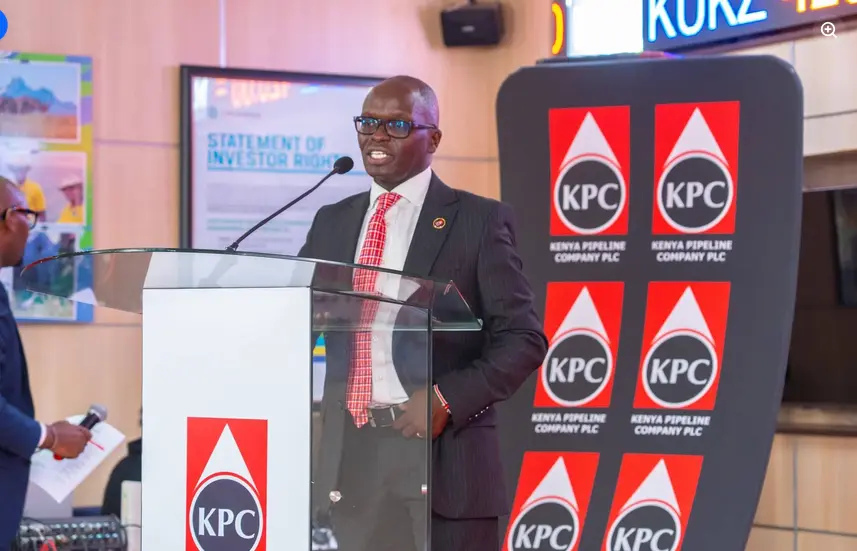
(NAIROBI, KENYA) – Kenya Pipeline Company is considering a set of financing options to protect its cash reserves for heavy capital spending on projects in the medium term.
The recently listed utility is weighing the sale of infrastructure bonds to raise cheap capital and the issue of bonus shares to shareholders to ease pressure from dividend payments that reduce its cash pile.
The firm closed the year ended June 2026 in a strong cash position with KES 20.5 billion ($158.8 million) in its books, but says the costly nature of its capital projects requires caution as it balances dividend demands against capital preservation for project funding.
“Our cash reserves are good and healthy and it tells you that we can be able to meet obligations as and when they arise and we are able to invest adequately as an organization. However, we have just declared a dividend of about KES 6.0 billion ($46.5 million) which once the shareholders approve at the forthcoming AGM will bring down the cash,” KPC Managing Director Pius Mwendwa told the Business Daily.
“The remaining cash is meant for investment in the company and we are looking at significant outflows in the coming years and especially in the next three or four years.”
Mwendwa says among the top considerations is the possible issue of bonus shares, which refers to a situation where a listed entity creates new shares and distributes them to existing shareholders at an agreed ratio in proportion to their shareholding.
A bonus issue of shares allows companies to preserve capital for future growth plans because, from an accounting treatment, the company converts a portion of its retained earnings into paid up equity, meaning cash only moves internally on the balance sheet from reserves to capital stock.
For the year ended June 2026, KPC announced a proposed dividend of KES 0.32 per share, translating to a total dividend payout of KES 5.9 billion ($45.7 million).
“This is a market that is very dividend sensitive and obviously every shareholder expects returns but we have to strike a balance between growing the business and paying the shareholder, a balance that has to be agreed by all parties. We are looking at various alternatives,” Mwendwa says.
“One is that we could finance some projects through debt, commercial or otherwise. We can do project financing; we can also do infrastructure bonds just to be able to maintain this balance. We could also consider doing bonus shares to shareholders because if you look at our balance sheet, you will realise we have quite healthy reserves.”
According to KPC, undertaking a single project could cost the company between KES 60.0 billion ($464.6 million) and KES 70.0 billion ($542.0 million), requiring faster efforts to build up its cash position to meet such infrastructure spending when it arises.
“The last mega project we did was Line 5 which was the replacement of Line 1 from Mombasa to Nairobi, a 450 kilometre pipeline. That was eight years ago and we spent upwards of KES 50.0 billion ($387.2 million). If we were to do a line today of the same magnitude we would probably be talking about KES 60.0 billion ($464.6 million) or KES 70.0 billion ($542.0 million),” Mwendwa said.
“When we are financing most of our projects, especially those which are huge in capital outlay, we usually do a hybrid where about 30.0% is financed through equity and the remaining 70.0% through debt and that is what we continue doing.”
In the twelve months ended June 2026, KPC’s net earnings grew 13.1% to KES 11.58 billion ($89.7 million) while the firm’s total revenue grew 8.8% to KES 42.98 billion ($332.9 million). In the same period, the company’s total assets grew 6.15% to KES 149.27 billion ($1.16 billion).