





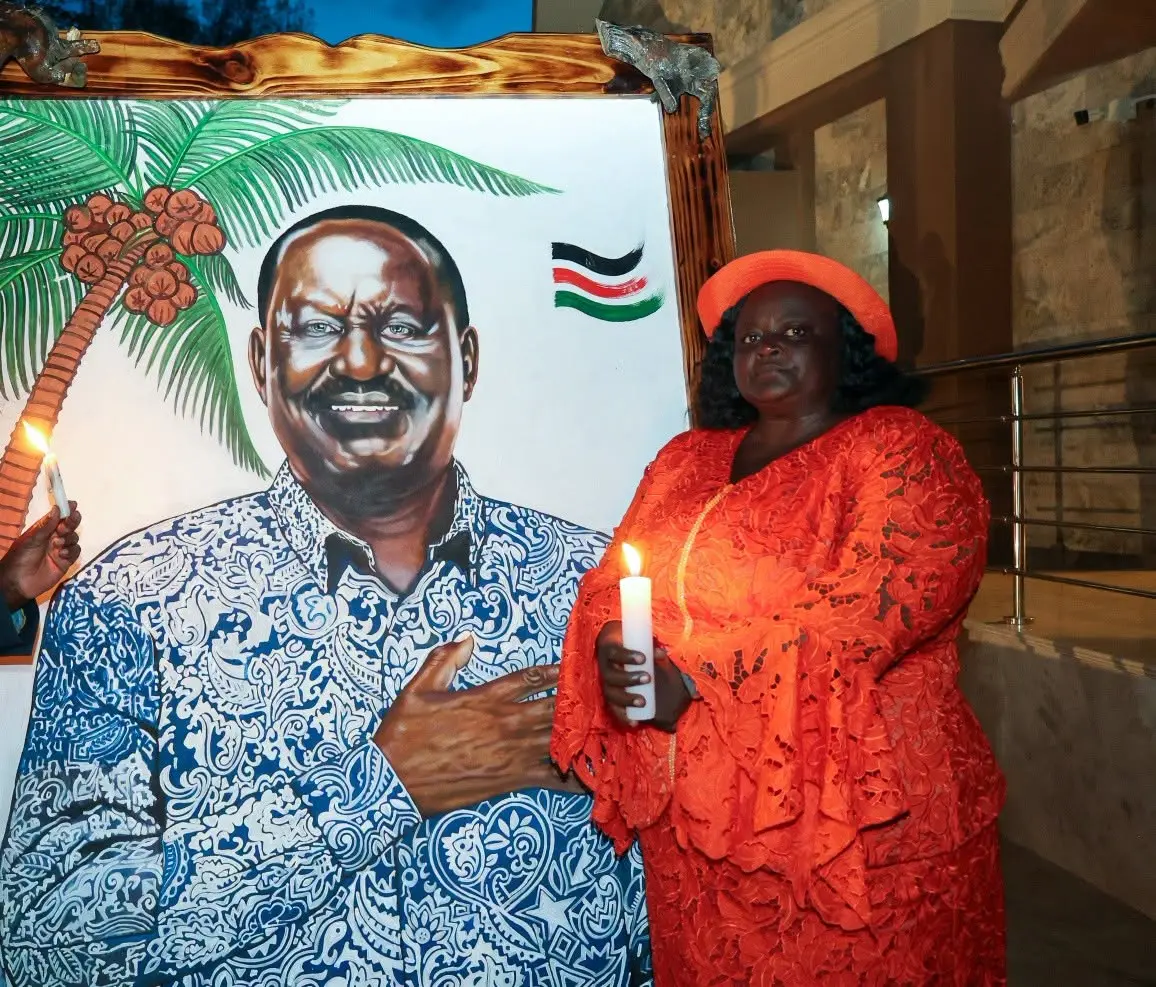
(NAIROBI, KENYA) – A Kenyan gas cylinder manufacturer has relocated to a larger factory and restructured its board and shareholding, one year after the death of its founder Raila Odinga, as the family owned business group adjusts to new leadership.
East African Spectre, the 50 year old gas cylinder manufacturer, shifted its operations to a bigger plant equipped with the latest machinery in January this year.
The company, which Raila Odinga started in 1971 by selling his Opel, had long operated from Mombasa Road, behind Panari Hotel.
In January, it relocated to a more strategic location close to the Nairobi Inland Container Depot in Embakasi, leaving its 50 year old factory as a storage facility.
The new plant sits on 2.7 acres of land and can produce 2,000 gas cylinders in a single eight hour shift. It can also revalidate 1,500 cylinders in the same time.
Meanwhile, Be Energy, an oil and gas company in which the Odinga family held a 35% stake, has undergone a shake up of its ownership structure and boardroom, with the Raila family taking a back seat in the day to day operations of the company that is majority owned by Saudi’s Bakri family.
New directors, Jackson Awele, one of the former Prime Minister’s lawyers, and William Ojonyo, Oburu and Raila’s cousin, have taken up boardroom seats initially occupied by Raila Odinga Junior and Oburu Odinga.
Mr Awele was part of a battery of 42 lawyers who backed Raila, then opposition candidate, in his case against President William Ruto at the Supreme Court and the suit that was linked to the push to amend the Constitution via the Building Bridges Initiative.
The Bakri family owns 65% of Be Energy through International Energy World S.A., a firm registered in Panama.
Additionally, the 2,801 shares, or 35% stake, that the Odingas held through Pan African Petroleum Ltd have been transferred to Africanable Corporation, a company registered in the British Virgin Islands.
It is unclear whether Africanable Corporation is owned by the Odingas or whether the share transfer was the result of a sale.
However, the Odingas’ interest in the company has been kept alive by Ojonyo and Awele, who admitted to a major newspaper that Raila was his client and thus would not divulge information on when these changes were made as it would go against advocate client confidentiality.
“The information you are looking for, even if I had it, I would not ordinarily give it to you,” said Awele, before adding that he is restrained by advocate client confidentiality.
However, major significant movements seem to be taking place at the East African Spectre.
Beyond the decision to move the plant to the 2.7 acre land, a new leadership style is also emerging at East African Spectre following Raila’s death.
The directors of the company, mostly relatives of the late politician, are taking up other roles, with Oburu Odinga, Raila’s elder brother, replacing the former Prime Minister as the leader of the Orange Democratic Movement.
Spectre’s managing director, Ida Odinga, the late Odinga’s wife, has been appointed Kenya’s Permanent Representative to the United Nations Environment Programme.
Raila Odinga Junior is also eyeing the Kibra Constituency seat, which was once held by his late father.
The three are also board directors of East African Spectre, which means that physical contact between management and the board has reduced, with interactions becoming largely virtual, said East African Spectre general manager Hudson Chitala.
In the run up to Mr Odinga’s October 15 memorial, East African Spectre was chasing further financing for its operations and needed to apply for a loan whose documents needed the signatures and approvals of the managing director, Ida Odinga.
The documents were sent to Ms Odinga via courier. She signed them and sent them back.
Ms Odinga has opened her home to East African Spectre managers even past normal working hours and on some weekends and holidays whenever there is an urgent need for her input.
Much like her late husband, Ms Odinga quickly picks calls and responds to messages from Spectre managers as a form of adaptation due to her reduced presence at the company’s premises.
“There is also nothing like work from the office. Whether it is a weekend, you will call her,” said East African Spectre’s technical manager Lawrence Oloo.
Mr Chitala added that, just like her husband, Ms Odinga has given management a free hand to make important decisions involving the business, hence continuity is not pegged on availability of directors.
Technical manager Lawrence Oloo said that future generations at East African Spectre will miss out on Mr Odinga’s strategy of selling his vision to workers.
Mr Oloo said the former Prime Minister would sell his vision for the company to interviewees and staff to have everybody on the same page.
“It is Baba who did my interview. He did not focus on the technical aspects of things. Instead, for interviews, he would start with telling you the history of the company and where it is headed, and then ask you to pick it up from there. He was somebody who could inspire you and sell his vision. That is something that people who will join later will not experience,” Mr Oloo added.
Spectre’s management is optimistic that the company will weather the storm that is Raila’s absence, tough as it is, just as they weathered a near similar one in the wake of Jaramogi’s death.
Other of the Odingas’ business interests remain unchanged a year after his death. They include real estate investment vehicle, Lennox Development Ltd, Kango Enterprises, Spectre International and Kisumu Development Trust Ltd.
But there is also an admission that it will be an uphill task to fill the void left by Odinga.
“We will miss his networks,” Chitala says.
Mr Chitala, the Spectre general manager, adds that Mr Odinga had a knack for unlocking the most complex of stalemates that the company found itself in.
Before his death on October 15 last year, Mr Odinga had quietly built a massive business empire comprising commercial interests accumulated systematically over decades, anchored around energy, manufacturing and family run holding structures that housed multi million shilling real estate.
The success of most of these ventures was bolstered by Odinga’s vast networks, which he built over the years, some through his political machinery.
With his death, East African Spectre is left to carry on without the late politician’s political networks and influence.
“Raila had a good network. Whenever we had problems, Raila would help us out. Now we have to do that on our own,” Mr Chitala adds.
Mr Chitala recalls a few years ago when Spectre International had applied for a loan so that it could upgrade the machines and equipment it uses to produce gas cylinders.
While the application was being processed, the expected timelines for completion had passed and the East African Spectre management was unsure of what to do, so he shared the challenge with Mr Odinga.
Mr Odinga made a call to the chief executive of a leading lending institution. After a brief discussion, the chief executive said, “consider it done”.
The following day, officials of the lender came to their premises and helped unclog the pipe that had delayed the financing.
In January, East African Spectre relocated its operations to a new factory in the Kyangombe area, a result of that financing.
A combination of age, East African Spectre’s more than 50 years in the industry, and the four year old plant in Kyangombe has helped thrust the firm into the government’s subsidised gas cylinders programme.
While the cylinders are filled and distributed by oil marketing companies, they are manufactured at East African Spectre’s plant.