



(NAIROBI, KENYA) – The parent firm of Kenya’s Toyota dealer has joined a consortium investing KES 2 billion ($15.5 million) in a sanitary pad factory in Nairobi, marking the latest expansion by Japanese multinational Toyota Tsusho Corporation.
The operation will be run by Unicharm Corporation, which owns the global feminine hygiene brand Sofy and is the lead investor in the partnership with a 75% stake.
The other members of the consortium are Toyota Tsusho Corporation with a 17.5% stake and its Kenyan subsidiary CFAO Kenya Limited with 7.5%. Toyota Tsusho has multiple businesses in Kenya, including CFAO Mobility Kenya, which sells various motor vehicle brands such as Toyota.
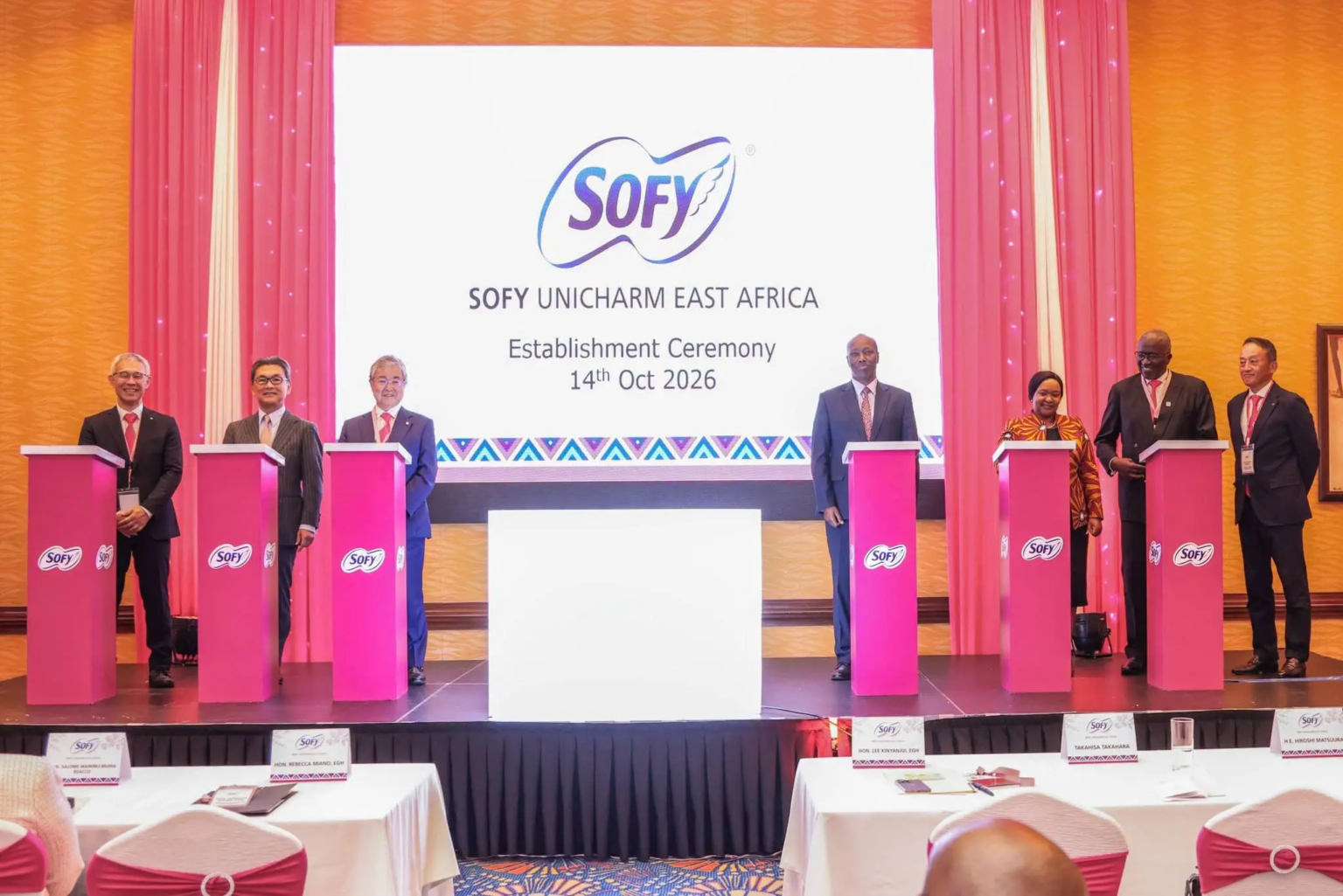
The new company, Sofy Unicharm East Africa, started operations in September 2026 and will manufacture and distribute sanitary products in Kenya while expanding sales and exports to neighbouring countries.
The business aims to generate KES 1.5 billion ($11.6 million) in revenue and reach two million women across East Africa by 2030, while expanding distribution and promoting menstrual hygiene education.
“The new company will integrate product development, production, sales and marketing in Kenya, with plans to expand the supply and export of sanitary products to neighboring East African markets. Representing an investment of KES 2 billion ($15.5 million), the joint venture underscores the partners’ commitment to driving regional growth, strengthening local manufacturing capabilities and contributing to the economic development of East Africa,” Takahisa Takahara, President and Chief Executive Officer of Unicharm Corporation, said.
Under the arrangement, Unicharm will contribute its expertise in product development and manufacturing, Toyota Tsusho will support business expansion and regional trade, while CFAO Kenya will handle local sales and distribution through its logistics network.
“We are participating in this business not only because we strongly identify with Unicharm’s philosophy, but also because we believe Toyota Tsusho has a unique role to play. By drawing on our experience and capabilities, we will help establish this philosophy in East African society and develop this initiative into a sustainable business for the long term,” Kazuyuki Urata, the Circular Economy Division CEO at Toyota Tsusho Corporation, said.
The venture builds on the partners’ existing operations in Kenya. In 2023, Unicharm and CFAO Kenya began importing and selling Sofy deep absorb sanitary pads from Unicharm’s factory in Egypt.
Amb. Dennis Awori, chairman of CFAO Group Kenya and country delegate, said the joint venture would strengthen local manufacturing, develop industrial skills and improve product availability by building a supply system that responds more closely to local demand.
“Lasting growth comes from understanding the customer and responding with products that combine quality, affordability and availability,” he said.
The expansion comes as manufacturers compete for a share of Kenya’s menstrual hygiene market, where disposable sanitary pads dominate despite affordability remaining a concern for some consumers.
According to the 2022 Kenya Demographic and Health Survey, 91% of women aged 15 to 49 years who were at home during their last menstrual period used disposable sanitary pads, while 5% used reusable ones.
The market includes international brands such as Always and Kotex, as well as locally produced products such as Femistyle, with prices and distribution influencing competition.
Sofy products are sold through supermarkets, online retailers and neighbourhood shops. Some local shops sell packs for about KES 50 ($0.39) and individual pads for KES 10 ($0.08). Online listings on Jumia Kenya have offered Sofy deep absorb eight pad packs for around KES 119 ($0.92) and 14 pad packs for about KES 225 ($1.74).