







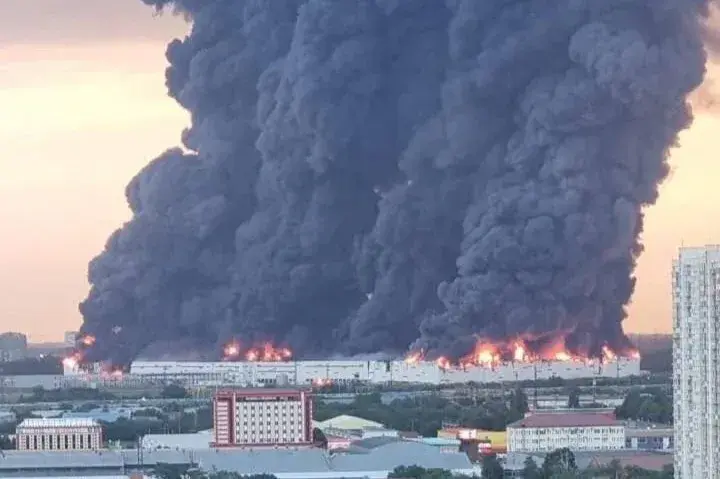
(KYIV, UKRAINE) – Ukrainian drone strikes against logistics centres belonging to Wildberries, Russia’s largest online marketplace, are opening a new front in the economic dimension of the war. The attacks aim not only to disrupt supply routes used by the Russian military but also to weaken a major private business with deep ties to Russia’s banking system.
Wildberries controls roughly 45 percent of Russia’s e-commerce market. The company’s turnover exceeded 6 trillion roubles, equivalent to approximately 63 billion US dollars or 50 billion British pounds, in 2025. Its logistics network includes dozens of vast warehouse complexes that form the backbone of its business model. This concentration of large facilities has made the company particularly exposed to drone strikes.
Ukrainian forces initially focused long range drone attacks on military enterprises, oil refineries, ammunition depots and airfields. The target list has since widened. President Volodymyr Zelenskyy has stated that logistics centres are used not only for civilian trade. According to Zelenskyy, dual purpose goods, military supply items and equipment needed to sustain Russia’s wartime economy can move through marketplace infrastructure.
The destruction of a warehouse means far more than the loss of a building or stored goods. A modern logistics complex functions as a transport hub through which millions of products pass. When a facility is put out of action, the company must redirect flows to other sites. This increases delivery times, raises transport costs and places extra strain on remaining warehouses.
After a series of strikes, the company was forced to seek alternative storage space, including outside Russia. Russian media reported that Wildberries considered leasing significant capacity in Kazakhstan. A logistics complex in Belarus also gained importance as a reserve centre following the loss of some Russian facilities. However, new warehouses must be found, equipped, integrated into the existing system and staffed, a process that cannot be completed quickly.
The consequences extend well beyond e-commerce. Hundreds of thousands of sellers operate on the Wildberries platform, storing goods in the company’s warehouses and using its logistics and credit programmes. When warehouses are destroyed, losses are felt not only by the marketplace owners but also by tens of thousands of entrepreneurs. For many sellers, the loss of goods means an inability to meet credit obligations, pay taxes or continue trading. Some analysts point to a risk of a domino effect, where problems at one large company gradually spread to connected sectors.
The financial dimension is attracting increasing attention. Mykhailo Podolyak, adviser to the head of the Office of the President of Ukraine, said in an interview with DW that disrupting logistics is only one objective of the strikes. Podolyak noted that Wildberries carries a very large credit portfolio. He said heavy losses at the company could affect major Russian banks, naming Sberbank, VTB, Alfa-Bank and PSB. Podolyak added that the losses could reduce revenues flowing into the Russian budget and create additional social pressure inside the country.
Denys Shtilerman, co-owner of Ukrainian defence firm Fire Point, offered a similar assessment. He said further weakening of the largest marketplaces could increase problems for banks that have actively lent to the sector.
Public financial reporting from Wildberries is far thinner than that of its main competitor Ozon. Available documents show the company’s credit burden has grown rapidly. According to Russian accounting records, short term loans at Wildberries’ main operating company increased almost eightfold over the course of a year, reaching more than 800 billion roubles, or roughly 8.4 billion US dollars and 6.7 billion British pounds. Several Russian media outlets, citing sources, have estimated the group’s total debt burden at approximately 1.3 trillion roubles, equivalent to about 13.7 billion US dollars or 10.9 billion British pounds. Some of these loans are reported to be held with VTB. The exact structure of the credit portfolio cannot be independently confirmed because the company does not publish full consolidated accounts.
The Central Bank of Russia had drawn attention to the rapid accumulation of debt by large technology companies even before the drone strikes began. In its financial stability review, the regulator noted that the combined debt of the largest Russian tech firms had grown by more than half over the year, reaching about 2 trillion roubles, or roughly 21 billion US dollars and 16.7 billion British pounds. The central bank observed that assets at these companies were increasing more slowly than debts. It separately pointed out that the rapid expansion of big marketplaces involved large scale investment in warehouse infrastructure, the very assets now being targeted by Ukrainian strikes.
Following the series of strikes, Russian media reported that Wildberries co-owner Tatyana Kim approached the Russian government requesting support. The Kremlin confirmed the situation was receiving government attention, though no concrete decisions were announced at the time. Representatives of VTB have said the bank is ready to consider various forms of credit support for the company. This position is logical given that VTB is both a major creditor of the marketplace and recently announced a strategic partnership with the RWB group, which includes Wildberries. Any large scale state support would require additional budget resources at a time when the Russian budget is already operating with a significant deficit.
Expert views differ on the longer term effects of the strikes. Some believe that even significant losses at individual warehouses will not bring down a company of Wildberries’ scale, arguing that the state and banks will not allow the bankruptcy of one of the country’s largest marketplaces. Others point out that the systematic destruction of logistics infrastructure steadily raises business costs, makes loan servicing harder, creates problems for sellers and increases the burden on the financial system.