



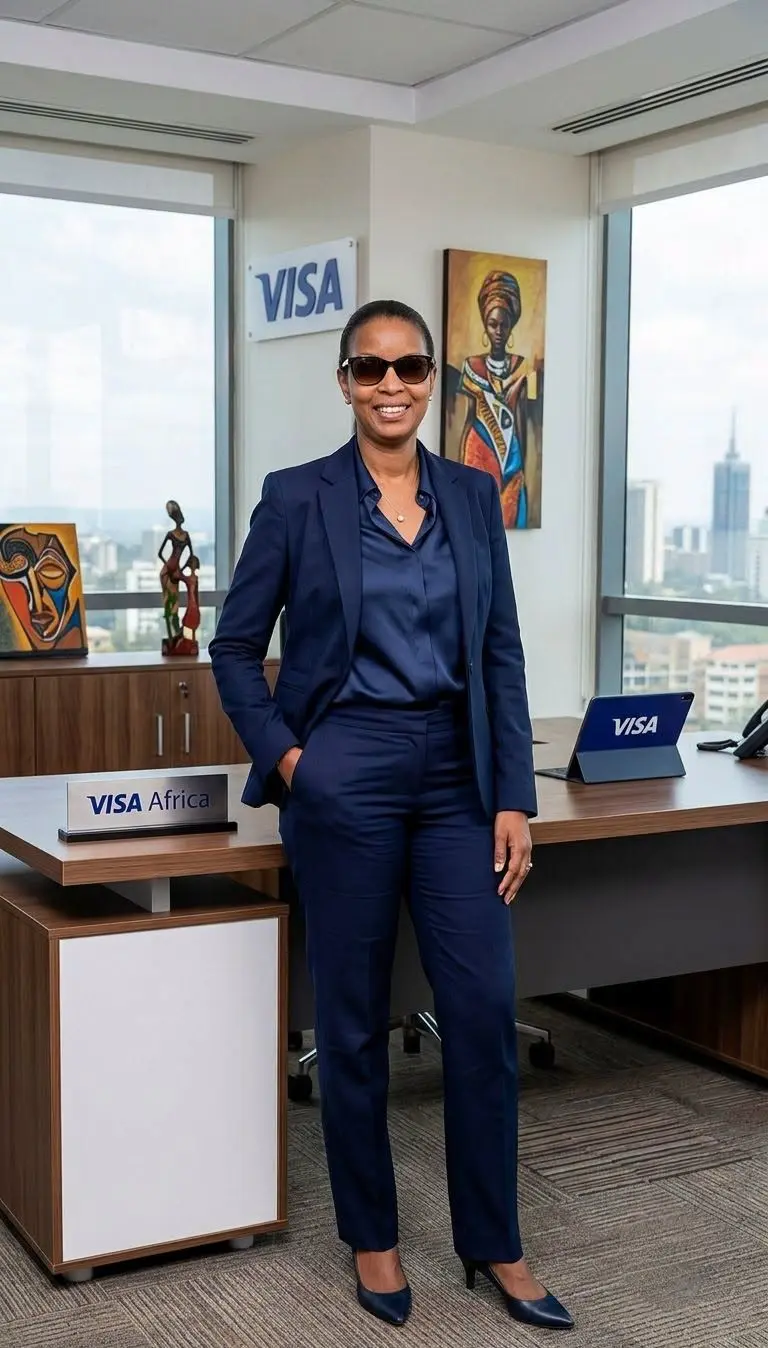
(NAIROBI, KENYA) – Anne Kinuthia-Otieno, the founding chief executive of Airtel Money Kenya, is leaving the mobile money business to take up a new role as Visa’s vice president and regional manager for East Africa.
Her exit ends a short but eventful period at Airtel Money during which she took on Safaricom’s M-Pesa and managed to win a slice of the mobile money market from the dominant player.
Ms Kinuthia-Otieno helped strengthen Airtel Money’s position in a market long controlled by M-Pesa. Her move to Visa marks another step in a long career in finance and shifts her focus to cross border payments.
She built her fintech career at Barclays Bank, now Absa, at a time when banks were known more for physical branches than mobile services. She was appointed the first chief executive of Airtel Money Kenya as a standalone business in 2022.
At the time, banks were competing for a share of digital money. Financial services still depended on branches, paperwork and face to face meetings that left out a large part of the informal economy.
Ms Kinuthia-Otieno worked to change this through various roles at Absa, including Director of Governance and Controls, Sales and Distribution Director, Products Director, and Head of SME Banking. At Absa, she helped develop the bank’s first mobile digital wallet, which allowed customers to open accounts and access services through their phones.
Her biggest test in pushing financial inclusion came when she joined Airtel Money in October 2022. She has since said the four years at the helm of what she once called a challenger brand involved blood, sweat and tears.
She said in a past interview that growing the brand was difficult in a market with a dominant player, and that it kept her awake at night thinking about how to create impact.
Her leadership of Airtel Money’s effort to claw back market share from M-Pesa after years of failed attempts has defined her legacy. She did not upend M-Pesa’s dominant position, which still commands nearly 90% of the market, but she sent a strong message to the competitor.
Airtel Money has grown its market share to 10.9% as of March 2026, while M-Pesa’s share has fallen to 89.1% from its near total dominance four years ago.
In four years, Airtel Money has grown its subscriber base more than fivefold, from 1.1 million in June 2022 to about 5.8 million by March 2026. Its market share climbed from 3.1%.
Ms Kinuthia-Otieno said people often assume that competing with a dominant market leader is only about market share. While that is important, she said she saw it differently. She said one of the things she is proudest of is that Airtel Money became a stronger and more credible participant in Kenya’s payments ecosystem. She said the company showed that healthy competition benefits consumers, merchants and the broader economy.
The Central Bank of Kenya also played a key role in the achievement. The regulator pushed for mobile money services to be separated from traditional telecommunications services. It also pushed for interoperability, allowing customers to send money across different mobile money platforms.
Ms Kinuthia-Otieno said in a June 2024 interview that interoperability, made possible with the help of the regulator, had enabled customers to pay bills online through a competitor’s paybill number.
For years, Airtel Kenya believed its fighting chance lay in having M-Pesa separated from the other telecommunications services offered by Safaricom to level the playing field. Airtel appeared to have given up on mobile money, believing its best chance lay in calling, texting and browsing services.
Airtel executives saw M-Pesa as the product that kept customers locked into Safaricom’s network. Competing against Safaricom was difficult because subscribers were tied by the pull of M-Pesa, with customers staying on the network even when Airtel tried to lure them with lower call and SMS charges.
Regulators and legislators pushed back, arguing that splitting M-Pesa or declaring Safaricom dominant would punish success. This changed when the Central Bank of Kenya stepped in, insisting on the separation of mobile money services from other telco services in line with the National Payment System Act, 2011.
The financial regulator said separating mobile money from telecommunications services would make it easier to regulate the sector and protect mobile money businesses from shocks in other services.
The Central Bank of Kenya licensed Airtel Money as a Payment Service Provider on January 21, 2022, and granted it a transition period to complete the separation. Six months later, Airtel Networks Kenya spun off its mobile money business into a separately run entity after minority shareholders entered the venture.
Safaricom has not completed its separation of the mobile money unit. Reports say the move has been delayed by a KES 75 billion tax liability that will arise after the spinoff. That is about $578 million and £457 million.
The spinoff of Airtel Money came after London listed Airtel Africa Plc sold a 25.77% stake in its local mobile money business as part of a continental deal that raised $550 million, or KES 65.2 billion and £435 million, from four institutional investors.
The multinational’s interest in Airtel Money Kenya dropped to 74.23% in the year ended March from 100% a year earlier. Both Airtel Networks and Airtel Money remain subsidiaries of the Dubai based Airtel Africa.
Airtel Money had operated for years but struggled to turn its presence into meaningful competition against M-Pesa’s scale. Ms Kinuthia-Otieno’s first challenge when she joined was not market share but confidence. After years of operating in the shadow of a dominant rival, the organisation’s confidence was at its lowest point.
She said the company focused on strengthening partnerships, creating an agent network, creating visibility in the market, improving customer experience, investing in operational resilience and building a culture where innovation and execution go hand in hand.
Rather than making M-Pesa the centre of every decision, she said she pushed Airtel Money toward understanding customers, agents and partners and identifying problems competitors were not addressing. She said she wanted the company to become obsessed with customers, understand their frustrations, identify opportunities others were not addressing and build solutions around those needs.
Under her leadership, the company strengthened its agent network and partnerships at a time when Kenya’s payments industry was moving toward greater interoperability between competing platforms. Interoperability reduced some of the friction that had tied customers to individual mobile money networks, giving smaller operators more room to compete.
Ms Kinuthia-Otieno said the company worked well with the regulator and thanked the Central Bank of Kenya for its support, especially in driving interoperability.