

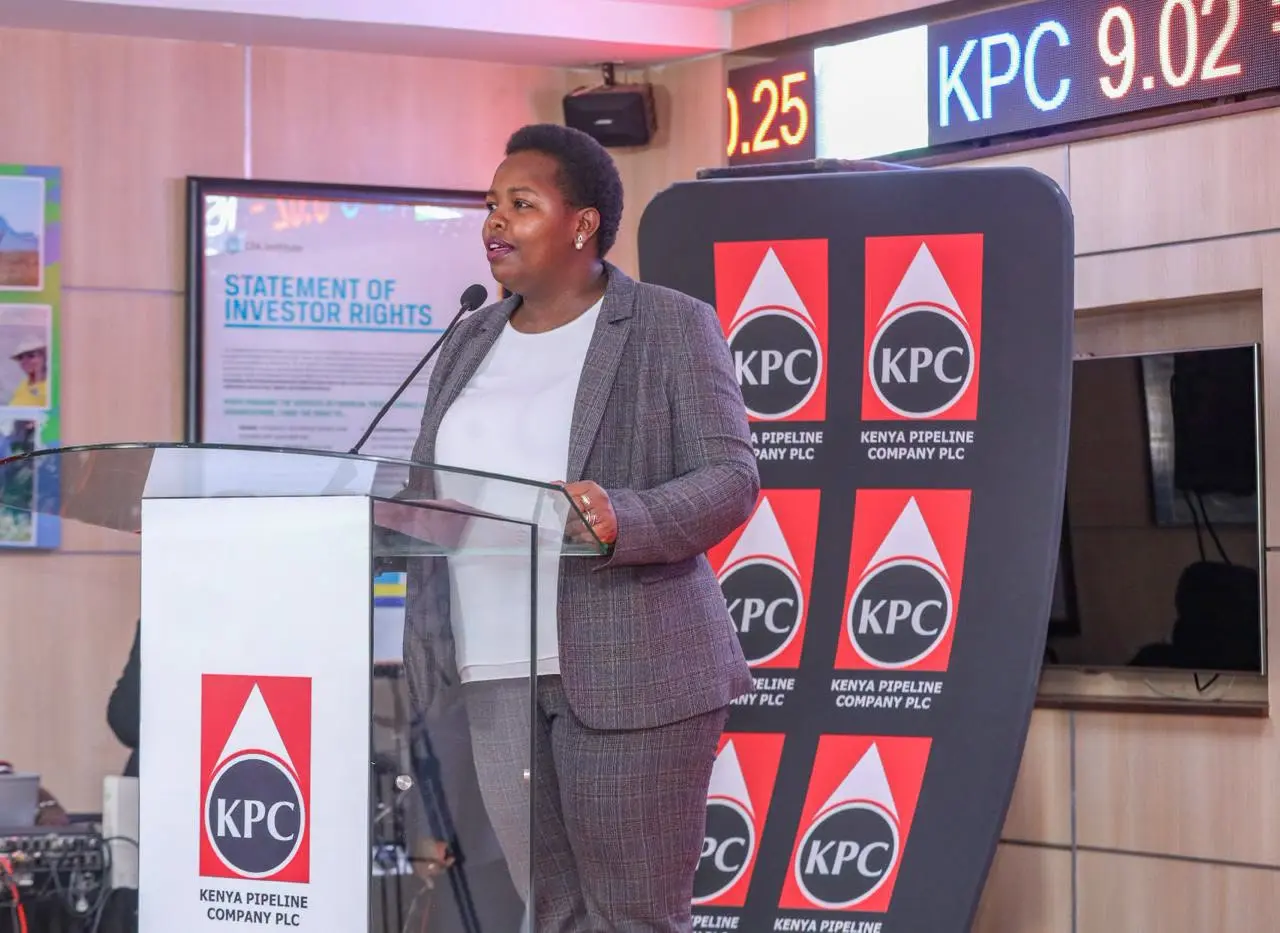
(NAIROBI, KENYA) – Unidentified investors have transferred 4.5 billion shares of Kenya Pipeline Company (KPC) worth KES 42.5 billion ($329 million) through the Nairobi Securities Exchange (NSE).
The block trade equals 24.76% of KPC’s issued shares, staying below the 25% threshold that would have required approval from the Capital Markets Authority (CMA).
The parties involved were East Africans, according to a market report shared by stockbrokers. Many brokers struggled on 19th October to identify the buyers and sellers of the shares, which began trading on the NSE on 9th March.
A major news outlet established that Rock Investment Bank was the broker that sold the shares. A client fronted by KCB Capital bought them.
“The block trade was concluded through the Block Board provided for in the NSE trading rules,” the NSE said in its daily trades disclosure. KPC closed at KES 9.02 ($0.07), up 0.22%.
The transfer has drawn attention to Uganda, the National Social Security Fund (NSSF) and the Public Servants Pension Scheme. These are the only KPC shareholders able to transfer 4.8 billion shares through a block trade.
Under the NSE Equity Trading Rules, block trades are executed through a dedicated trading board. They are subject to minimum transaction size requirements and disclosure rules meant to promote transparency.
Trades worth more than KES 3 billion ($23.2 million) must make up at least 5% of an issuer’s total issued shares. Trades worth less than that must make up more than 15%.
In both cases, the shares traded are capped at a maximum of 24.99% of a company’s total shares. The cap prevents unintended takeover bids without a formal prospectus.
At KES 9.02 ($0.07), the shares sold at nearly the same price as KPC’s listing on the NSE. The government priced the initial public offering (IPO) at KES 9 ($0.07) per share. The offer opened on 19th January and ran until 24th February. Trading began on 9th March.
Uganda and 13 State backed pension schemes and agencies put in KES 95.8 billion ($741 million) of the required KES 106.3 billion ($823 million), according to confidential documents seen by Business Daily.
The NSSF bought shares worth KES 38.5 billion ($298 million). Uganda followed with KES 33 billion ($255 million), the Public Servants Pension Scheme with KES 13 billion ($101 million), the County Workers Pension Fund with KES 3.6 billion ($27.9 million) and the Unclaimed Financial Assets Authority with KES 3.2 billion ($24.8 million).
Pension funds for Kenya Power, KPC and Kenya Ports Authority (KPA) workers also took part heavily in the offer.
The offer was 105.7% subscribed, raising KES 112 billion ($867 million) against the State target of KES 106 billion ($821 million). Without the NSSF, Uganda and the pension fund, the IPO would have failed to reach its success level.
About 90% of KPC’s top owners bought their shares through proxies during the IPO. This kept the identity of the investors hidden.
Regulatory filings show that 18 of KPC’s top 20 shareholders hold shares under nominee accounts. Nominee accounts are registered to hold shares on behalf of the true owners. The structure is used globally and at firms listed on the Nairobi bourse to hide the identity of beneficial owners.
The NSSF and State agencies also split their stake across several nominee accounts, hiding their position as KPC’s largest shareholders.
The offer’s success was weakened by low uptake among foreigners, high net worth private investors, retail investors and oil marketers. Many had viewed KPC as a strategic investment.
Local retail investors bought shares worth KES 4.1 billion ($31.7 million) against their allocation of KES 21.2 billion ($164 million). Foreigners spent KES 32.7 million ($253,000) compared with their target of KES 21.2 billion ($164 million).
Oil marketers took shares worth KES 22.9 million ($177,000), or 0.14%, of the KES 15.9 billion ($123 million) allocated to dealers who rely on the pipeline.
The heavy presence of local institutional investors and Uganda suggests the IPO was seen as a long term strategic investment.
The KPC trade follows a series of large block trades on the NSE as the bourse seeks to deepen liquidity and improve transparency around big share transfers.
The most notable was the KES 204.3 billion ($1.58 billion) sale of a 15% Safaricom stake by the government to Vodacom. The deal involved 6.009 billion shares and was the largest single transaction ever conducted on the bourse.
Diageo has also used the block trade mechanism to raise its stake in East African Breweries (EABL). It acquired 14.97% of the brewer for KES 22.73 billion ($176 million) in 2023, lifting its total holding to 65%.
KPC’s net profit rose 13% to KES 11.58 billion ($89.6 million) in the year to June 2026. The firm will pay KES 5.81 billion ($45 million) in dividends.