



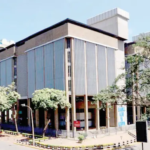





(NYERI, KENYA) – The Kenya Film Commission (KFC) has opened an ultra modern cinema theatre and film hub at Dedan Kimathi University of Technology (DeKUT) in Nyeri, in a move aimed at strengthening film distribution, talent development and creative entrepreneurship.
The cinema, named KFC-CineHub, will act as a film exhibition and audience development centre. It will support capacity building, research and innovation, talent incubation and creative entrepreneurship under one roof.
The centre will bring infrastructure closer to audiences, filmmakers and content creators. It will also widen distribution networks for locally produced content and unlock monetisation opportunities for creatives.
In a speech read on his behalf by Noah Otiende, Director at the Directorate of Films, Youth Affairs and Creative Economy Principal Secretary Fikirini Jacobs said the facility would help translate government policy into practical opportunities for young people. He noted that the cinema will offer practical solutions to longstanding challenges facing the creative industry.
“The cinema is an example of how the government is translating policy into practical opportunities for our citizens. I therefore wish to encourage students, filmmakers, and creatives to make full use of this facility. Let it be a hub of creativity, let it be a hub of collaboration and excellence, and let it be a space where you can be able to transform ideas into productions that showcase Kenya’s talent and culture,” the PS said.
Fikirini said the government is committed to strengthening the creative ecosystem through partnerships, institutional development and investment. He said that through KFC, the state would continue supporting creatives to market and distribute their content.
The PS challenged graduates and emerging creatives to use their skills to tell Kenyan stories, establish enterprises, create employment and compete in international markets.
“Please use your skills to tell our stories. Use your skills to build enterprises. Use your skills to create jobs and compete globally. Above all, remember to be bold. Remember to be disciplined. Remember to be committed to excellence,” he said.
The Nyeri facility joins a growing network of KFC supported film hubs. Other hubs set up as part of the Commission’s strategy to decentralise film opportunities include the Uriri Film Hub in Migori County and the Bomet Film Hub in Bomet County.
The launch coincided with the graduation of 139 young creatives who completed an intensive seven day film capacity building programme delivered by KFC, DeKUT and the Kenya Film School. The training provided participants with hands on training in screenwriting, acting, directing, cinematography, editing, sound, lighting and production.
KFC Board Chairman Sudi Wandabusi said the facility should not be viewed merely as a cinema hall but as an important component of Kenya’s wider film exhibition and audience development ecosystem. He said the hub would provide an opportunity to develop audiences, test content, gather data on audience preferences and create stronger links between filmmakers and the market.
Wandabusi challenged stakeholders in the creative industry to ensure that the facility is used for its intended purpose and does not become underutilised.
“I am particularly pleased that this project brings together the Kenya Film Commission and DeKUT, which is an institution of learning. We must collaborate as government, academia, filmmakers, producers, distributors, exhibitors, broadcasters, technology companies, investors, and development partners to increasingly work as an interconnected ecosystem. My prayer is that this partnership should continue to generate research, innovation, industry, diligence, and practical solutions that can strengthen Kenya’s film ecosystem,” Wandabusi said.
KFC Chief Executive Officer Timothy Owase said the hub has potential to transform the creative industry in the county as both an entertainment hub and a platform for preservation of culture. He said the investment was not only in physical infrastructure but also in Kenya’s creative economy and the next generation of storytellers.
“This is a gateway to imagination, a platform for talent, and a home for Kenyan stories. Cinema has the unique power to entertain, educate, and inspire through film. We tell our stories, preserve our heritage, challenge perceptions, and showcase the richness of who we are as a people,” Owase said.
“A facility such as this therefore represents an important investment not only in infrastructure but in Kenya’s creative economy and the next generation of storytellers,” he added.
Owase also praised the university’s leadership for recognising that modern education extends beyond the traditional classroom and requires spaces that nurture creativity and innovation. He encouraged students at DeKUT to take advantage of the facility by experimenting, learning, collaborating and creating.
“The next great Kenyan filmmaker, producer, cinematographer, actor, animation artist may be sitting among you here today. Do not wait for the opportunity to find you. Use this facility, learn, experiment, collaborate, and create,” he told the students.
He also called for continued cooperation between government and the private sector to develop the infrastructure, skills and markets needed for Kenya’s film industry to compete both across Africa and globally.
DeKUT Vice-Chancellor Prof. Peter Ng’ang’a said the project demonstrates the university’s commitment to empowering young people while showing how technology and creative arts can complement each other. He noted that the university’s students, particularly those trained in technical disciplines, had demonstrated that creativity transcends academic and professional boundaries.
The Vice-Chancellor said the new facility would provide students with an opportunity to develop their creative abilities while connecting their technical training with the growing demands of the creative economy.
“DeKUT is a tech university. These are presentations from engineers, computer scientists and all kinds of tech disciplines, but you can see how the arts bring everybody together and everybody has something to enjoy,” Prof. Ng’ang’a said.