


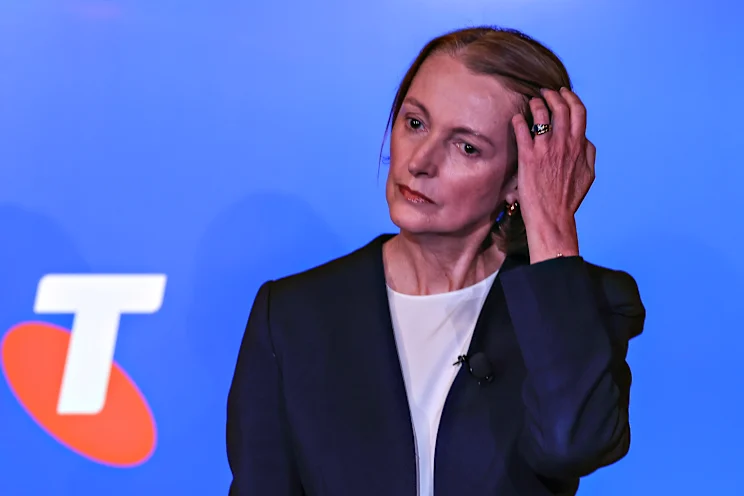
(SYDNEY, AUSTRALIA) – Telstra chief executive Vicki Brady has accepted personal responsibility for the national Triple Zero outage in July 2026, after the company’s board cut 607,000 Australian dollars (about 397,000 US dollars, or roughly 312,000 British pounds) from her short term bonus.
Brady spoke as Telstra delivered its annual results on Thursday. Net profit rose 2.7% to 2.4 billion Australian dollars (about 1.57 billion US dollars, or roughly 1.23 billion British pounds). Brady’s total pay rose 11% to 6.8 million Australian dollars (about 4.45 million US dollars, or roughly 3.49 million British pounds).
“There were things within our control that triggered the outage,” Brady said. “As CEO, ultimate accountability rests with me for the outage.”
Telstra directors cut her individual performance multiplier by 20 percentage points, leaving her a short term bonus of 2.762 million Australian dollars (about 1.81 million US dollars, or roughly 1.42 million British pounds). Then group executive of global networks and technology Shailin Sehgal took the same reduction. The rest of the senior executive team, including chief financial officer Michael Ackland, lost 10 points each. That took a further 1.29 million Australian dollars (about 844,000 US dollars, or roughly 663,000 British pounds) out of the bonus pool.
Brady said the external investigation was still running. The board could impose further consequences through the 2027 financial year pay once it reports. She said executive targets for the current year were signed off in June, before the outage, and no allowance had been made for it.
The outage was caused by a server that had reached the end of its supported life almost a decade earlier. The device was never replaced, despite newer models costing less than 30,000 Australian dollars (about 19,600 US dollars, or roughly 15,400 British pounds).
Customers have largely stayed with Telstra. Brady said there had been some small impact on the day itself but no material change since in customers leaving or joining. Just over 30,000 customers have contacted the company. It has processed just under 1 million Australian dollars (about 654,000 US dollars, or roughly 514,000 British pounds) in credits.
Telstra said its direct workforce is now 4% smaller at 29,334 people. The company has signalled it will keep cutting jobs as it simplifies the business. The job losses lifted its redundancy bill by 92 million Australian dollars to 206 million Australian dollars (about 135 million US dollars, or roughly 106 million British pounds).
The cost cutting helped deliver shareholders a bigger dividend and a fresh 1 billion Australian dollar share buyback (about 654 million US dollars, or roughly 514 million British pounds).
Telstra’s full year results to June 30 showed net profit rose 2.7% to 2.4 billion Australian dollars. Core earnings climbed 3% to 8.2 billion Australian dollars (about 5.37 billion US dollars, or roughly 4.22 billion British pounds). Group revenue dipped 0.8% to 22.9 billion Australian dollars (about 14.98 billion US dollars, or roughly 11.77 billion British pounds).
Revenue at Telstra’s consumer arm, its largest, rose 0.7%. Its infrastructure arm, InfraCo, rose 3.4%. Those gains offset a 5.2% fall in the enterprise business and an 11.3% slump in the international unit.
The mobile division added 274,000 users. Most of these were wholesale customers on rival brands using Telstra’s network. Its own retail postpaid handheld services went backwards. The average monthly postpaid bill rose 3.8% to 56.20 Australian dollars (about 36.80 US dollars, or roughly 28.90 British pounds).
Asked whether customers could keep absorbing price rises when reliability was in question, Brady said running a mobile network took significant investment and pricing had to sustain it. She pointed to prepaid plans, no lock in contracts and Telstra’s MVNO partners as options for cost conscious customers.
The board lifted the full year dividend by 10.5% to 21 cents a share. Of that, 90.5% is franked. The planned 1 billion Australian dollar buyback follows the 1.25 billion Australian dollar programme completed in June. Brady said the buybacks sat alongside increased capital spending and strategic investment. They allowed Telstra to lower its cost of capital.
She said the outage had changed the conversation about the network. “Network resilience was brought into sharp focus,” she said. Australians’ reliance on connectivity “will only grow”, she added.
Telstra expects underlying earnings to grow to between 8.5 billion and 8.8 billion Australian dollars next year (about 5.56 billion to 5.76 billion US dollars, or roughly 4.37 billion to 4.52 billion British pounds). It plans to spend up to 3.65 billion Australian dollars on capital works (about 2.39 billion US dollars, or roughly 1.88 billion British pounds). The company said it would lift network investment to apply lessons from the outage.
The cost of major infrastructure projects, including its Aura fibre network, has blown out by 200 million Australian dollars to roughly 1.8 billion Australian dollars (about 1.18 billion US dollars, or roughly 925 million British pounds). Inflation and difficult site conditions drove the increase.
eToro analyst Josh Gilbert said guidance suggested management was not bracing for an outage driven exodus. He said reputational damage would not clear overnight, with the regulator’s inquiry still live. He said the dividend had done much of the heavy lifting for shareholders, who would eventually want the share price to pull its weight too.